Inside Wholesale Liquidation Pallets: How Resale Profits Work
Wholesale liquidation pallets give resellers an opportunity to purchase merchandise in bulk and resell individual products through online marketplaces, flea markets, discount stores, local marketplaces, and other sales channels.
But buying a pallet at a discounted price does not automatically mean you will make a profit. Successful liquidation reselling requires understanding what you are buying, calculating your total costs, researching demand, and having a realistic plan for selling the inventory.
In this guide, we’ll look inside wholesale liquidation pallets, explain the types of inventory you may encounter, show you how to evaluate resale potential, and explain the costs that can affect your final profit.
What Are Wholesale Liquidation Pallets?
Wholesale liquidation pallets are bulk lots of merchandise sold through liquidation and secondary-market channels.
The inventory may come from customer returns, overstock, shelf pulls, excess inventory, discontinued merchandise, seasonal products, or other sources of retail inventory.
Depending on the liquidation lot, a pallet may contain products from one category or a mixture of different products.
For a broader explanation of the liquidation industry, read our complete guide to what pallet liquidation is.
What Can Be Inside a Wholesale Liquidation Pallet?
The contents of a liquidation pallet depend on the supplier, category, source, condition, and available inventory.
Some common categories include:
- Electronics
- Clothing
- Home goods
- Tools
- Health and beauty products
- Kitchen products
- Toys
- General merchandise
- Seasonal products
Some buyers prefer specialized pallets because they already understand the products, while others prefer mixed merchandise because it gives them a wider selection of products to resell.
Wholesale Liquidation Pallets vs. Regular Wholesale
Wholesale liquidation is different from traditional wholesale purchasing.
Traditional wholesale inventory is generally purchased through established distribution channels with relatively predictable product selection and condition.
Liquidation inventory can be more variable. Depending on the source, it may contain returns, open-box products, overstock, shelf pulls, or mixed-condition merchandise.
This difference is important because the buyer needs to account for inspection, sorting, testing, cleaning, repairs, damaged packaging, and potentially unsellable products.
Understanding Liquidation Pallet Condition
Before buying a wholesale liquidation pallet, understand exactly how the merchandise is described.
Possible condition descriptions include:
- New
- Overstock
- Open box
- Customer returns
- Used
- Damaged packaging
- Mixed condition
Condition can have a major effect on your resale strategy.
For example, products in new condition may be easier to list at competitive prices, while returned or open-box merchandise may require additional inspection before it can be sold.
Always review the supplier’s specific condition description rather than assuming every pallet contains retail-ready merchandise.
What Is a Liquidation Manifest?
A manifest is an inventory document that provides information about the products associated with a liquidation lot.
Depending on the supplier, a manifest may include:
- Product descriptions
- Product quantities
- SKUs
- Model numbers
- Estimated retail values
- Condition information
A manifest can make it easier to research products before purchasing a pallet.
However, an estimated retail value should not automatically be treated as your expected sales revenue.
Your actual resale price depends on market demand, competition, condition, selling fees, shipping, and other factors.
How to Calculate the Real Cost of a Liquidation Pallet
One of the biggest mistakes new resellers make is looking only at the advertised pallet price.
Your real cost can include several additional expenses.
Pallet Purchase Price
This is the amount you pay for the liquidation pallet itself.
Freight and Shipping
Palletized freight can add a significant amount to your total acquisition cost depending on the destination, shipment size, carrier, and delivery requirements.
Storage
If you purchase multiple pallets, you may need warehouse or storage space.
Labor
Sorting, testing, photographing, listing, packaging, and shipping inventory all require time.
Marketplace Fees
Online marketplaces may charge listing, selling, payment processing, or other fees.
Packaging
Boxes, tape, labels, protective materials, and other shipping supplies can reduce your final margin.
Unsellable Inventory
Some liquidation inventory may not sell at the expected price. Damaged, incomplete, defective, or low-demand products can reduce your overall recovery.
Your basic acquisition calculation should therefore look like:
Total landed cost = pallet price + freight + other acquisition expenses
Retail Value Is Not the Same as Resale Value
This is one of the most important concepts for anyone buying wholesale liquidation pallets.
A product’s original retail price does not guarantee that you can sell it for that amount.
Suppose a pallet contains products with an estimated original retail value of $10,000.
That does not mean you will automatically generate $10,000 in sales.
Your actual sales may be affected by:
- Product condition
- Current market prices
- Competition
- Product popularity
- Seasonality
- Marketplace fees
- Shipping costs
- Customer returns
- Unsold inventory
For this reason, experienced resellers focus on realistic market prices rather than simply multiplying the retail value of the products.
How to Estimate Liquidation Pallet Profit
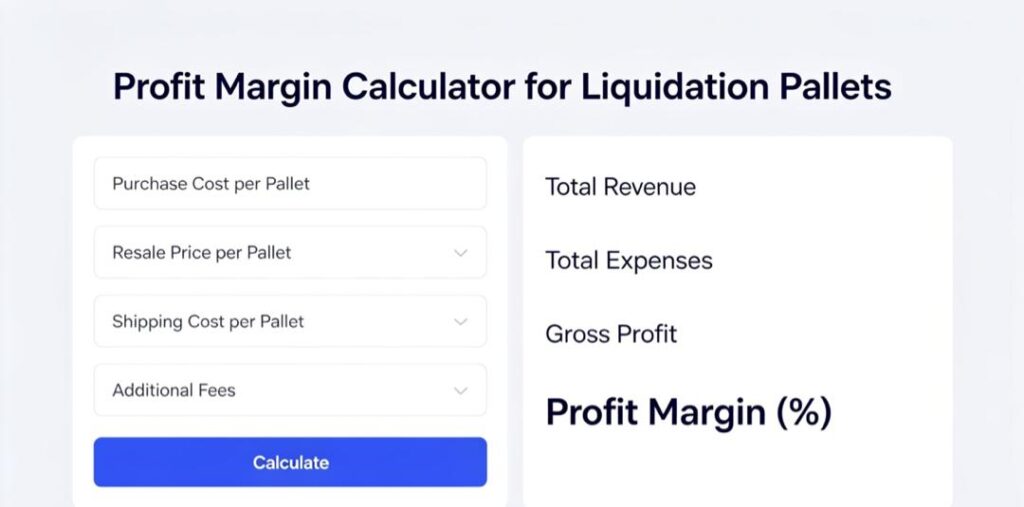
A simple way to estimate potential profit is:
Estimated profit = expected sales revenue − total costs
For example, imagine you purchase a hypothetical pallet for $1,200 and spend another $300 on freight and related acquisition costs.
Your total acquisition cost would be:
$1,200 + $300 = $1,500
If you eventually generate $2,500 in sales, your gross difference would be:
$2,500 − $1,500 = $1,000
However, this is not necessarily your final net profit because you may still have marketplace fees, packaging, labor, storage, returns, and other expenses.
The example is intended to demonstrate the calculation rather than predict actual results.
What Is Liquidation Pallet ROI?
ROI, or return on investment, is another useful measurement for evaluating a liquidation purchase.
A simplified ROI calculation is:
ROI = profit ÷ total investment × 100
Using the previous hypothetical example, if your profit before additional operating expenses were $1,000 and your investment was $1,500:
$1,000 ÷ $1,500 × 100 = 66.7%
Again, this is only a simplified example. A complete business calculation should include all relevant expenses.
Which Liquidation Pallets Can Be Good for Resellers?
The best category depends on your experience, customer base, selling channel, storage capacity, and budget.
Amazon Liquidation Pallets
Amazon liquidation pallets can contain a broad selection of merchandise depending on the specific lot.
Explore our Amazon Pallets category.
Walmart Liquidation Pallets
Walmart liquidation inventory can cover multiple retail categories and may appeal to resellers looking for varied merchandise.
Browse our Walmart Pallets.
Target Liquidation Pallets
Target liquidation pallets can provide access to different types of consumer merchandise depending on the available inventory.
Explore our Target Pallets.
Electronics Pallets
Electronics can be attractive to resellers who understand product specifications, testing, condition, and current market prices.
See our Electronics Pallets.
Clothing Pallets
Clothing pallets can provide a broad selection of apparel for online sellers, flea market vendors, discount stores, and other resellers.
Browse our Clothing Pallets.
General Merchandise Pallets
General merchandise pallets can contain products across multiple categories and may work well for resellers who operate several sales channels.
Explore our General Merchandise Pallets.
Health & Beauty Pallets
Health and beauty liquidation inventory can include cosmetics, personal care products, skincare merchandise, beauty accessories, and other consumer products.
Browse our Health & Beauty Pallets.
How to Choose a Wholesale Liquidation Pallet
Don’t choose a pallet based solely on the lowest advertised price.
Instead, evaluate the complete opportunity.
1. Understand the Category
Choose merchandise you understand or are willing to research thoroughly.
2. Research Demand
Look at current selling prices and completed sales where available.
3. Check Condition
Understand whether the inventory is new, returned, open box, used, or mixed condition.
4. Review the Manifest
If a manifest is available, research several of the listed products before purchasing.
5. Calculate Delivered Cost
Include freight and other acquisition costs rather than looking only at the pallet price.
6. Consider Your Selling Channel
Determine whether the products make sense for e-commerce, flea markets, local sales, retail, or another channel.
7. Plan Your Storage
Make sure you have enough space to receive and organize the merchandise.
How to Increase Your Chances of Successful Resale
Buying the right inventory is only the beginning.
Your resale process can also influence your results.
Sort Inventory Quickly
Separate products into categories such as ready to sell, needs testing, needs cleaning, damaged, and potentially unsellable.
Research Prices Before Listing
Don’t automatically copy the highest listing price you find. Look at the current market and comparable sales where possible.
Use Multiple Sales Channels
Depending on the merchandise, selling through multiple channels can help you reach different customer groups.
Create Accurate Listings
Use clear product descriptions, accurate condition information, good photographs, and relevant specifications.
Track Your Numbers
Keep records of purchase costs, freight, sales revenue, marketplace fees, returns, and other expenses.
Tracking your actual numbers will help you determine which categories are performing best for your business.
Common Mistakes When Reselling Liquidation Inventory
Buying Based Only on Estimated Retail Value
Retail value is not the same as current resale value.
Ignoring Product Condition
Condition can significantly affect what customers are willing to pay.
Forgetting Freight
A pallet that looks inexpensive can have a very different landed cost after shipping.
Overestimating Sell-Through
Not every product will sell immediately. Some inventory may require discounting or additional marketing.
Ignoring Marketplace Fees
Fees can reduce margins, especially on lower-priced products.
Buying More Than You Can Handle
Large quantities can create storage, cash-flow, and inventory-management problems.
How Many Pallets Should a Beginner Buy?
There is no universal number that works for every reseller.
The appropriate order size depends on your budget, storage capacity, experience, sales volume, and ability to process inventory.
If you are new to liquidation, starting with an amount you can realistically inspect, organize, list, and sell can help you learn your actual costs and sell-through rate before increasing purchasing volume.
Is Buying Wholesale Liquidation Pallets Worth It?
Wholesale liquidation pallets can be worthwhile for businesses that have a clear resale strategy and understand how to evaluate inventory.
However, liquidation should not be approached as guaranteed easy money.
The strongest buyers understand their numbers before purchasing.
They research demand, calculate landed costs, evaluate condition, plan their sales channels, and track actual results.
Frequently Asked Questions
What are wholesale liquidation pallets?
Wholesale liquidation pallets are bulk lots of merchandise sold through liquidation channels. They may contain customer returns, overstock, shelf pulls, excess inventory, discontinued products, or other merchandise.
Can I make money reselling liquidation pallets?
Reselling liquidation inventory can provide profit opportunities, but results vary. Actual profitability depends on acquisition cost, product condition, demand, selling prices, fees, shipping, and other operating expenses.
Are liquidation pallets cheaper than wholesale?
Liquidation pricing can be lower than traditional wholesale pricing in some situations, but the inventory can also have more variable condition and assortment. Buyers should compare total costs and expected resale value rather than price alone.
What is the best liquidation pallet to resell?
There is no single best pallet for every reseller. The right category depends on your experience, customers, sales channels, budget, storage, and ability to evaluate the products.
Should I buy manifested liquidation pallets?
A manifest can provide useful information about the inventory before purchase. However, buyers should still review condition, pricing, supplier terms, and realistic resale values.
How do I calculate liquidation pallet profit?
Start with expected sales revenue and subtract your complete costs, including the pallet purchase price, freight, selling fees, packaging, storage, labor, returns, and other expenses.
Start Sourcing Wholesale Liquidation Inventory
Wholesale liquidation pallets can give resellers access to bulk merchandise across a wide range of categories. The key is understanding what you are buying and calculating the numbers before you commit your capital.
Whether you are interested in retailer-specific inventory, electronics, clothing, general merchandise, or health and beauty products, choose inventory that fits your resale strategy.
When you’re ready to explore available inventory, visit our liquidation pallets for sale.
You can also browse our individual categories to find products that match your business:
- Amazon Pallets
- Walmart Pallets
- Target Pallets
- Electronics Pallets
- Clothing Pallets
- General Merchandise Pallets
- Health & Beauty Pallets
If you are ready to scale your resale operation with reliable inventory, Pallet Liquidation Mart is here to help you find the right liquidation pallets for resale for your goals and budget. We carefully source and organize our pallets so you can spend less time searching and more time selling. Explore our current pallet selection online, and if you have questions about what will work best for your business, contact us for personalized guidance.