Echo vs Milwaukee Tools Pallet: Which Is Better for Resale?
If you’re considering buying a tool liquidation pallet for resale, two brands worth comparing are Echo and Milwaukee. Both have strong brand recognition, but they serve different types of customers and product categories.
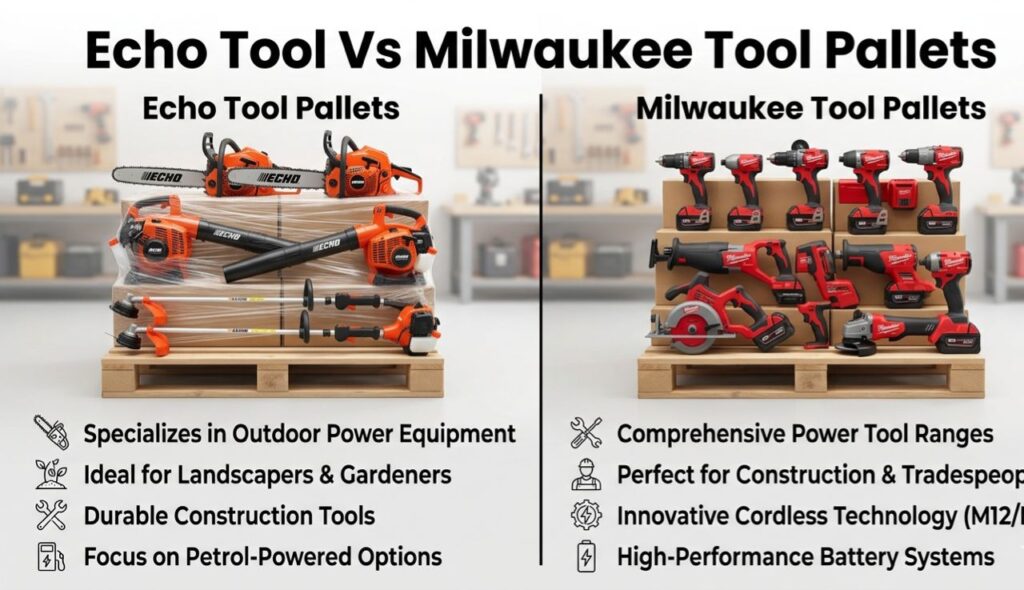
Echo is strongly associated with outdoor power equipment such as trimmers, blowers, chainsaws, hedge trimmers, and other landscaping tools. Milwaukee is better known for professional power tools including drills, impact drivers, saws, grinders, and other jobsite equipment.
So which is better for a reseller?
The answer depends on your customers, selling channel, product knowledge, storage space, and the specific pallet available. Rather than assuming one brand is automatically more profitable, it’s better to compare the two categories and determine which fits your resale business.
Echo vs Milwaukee: Quick Comparison
| Feature | Echo | Milwaukee |
|---|---|---|
| Main category | Outdoor power equipment | Professional power tools |
| Typical customers | Landscapers, homeowners, outdoor professionals | Contractors, tradespeople, DIY users |
| Common products | Trimmers, blowers, chainsaws, hedge trimmers | Drills, impact drivers, saws, grinders |
| Best selling environments | Local markets, tool stores, online marketplaces | Tool stores, online marketplaces, local resale |
| Product size | Often medium to large | Small to medium, depending on product |
| Inspection importance | High | High |
| Battery/accessory opportunity | Moderate | High |
| Suitable for flea markets | Yes | Yes |
The most important factor isn’t simply the brand. It’s whether the inventory matches the customers you already know how to reach.
What Makes Echo Tools Attractive for Resellers?
Echo is widely associated with landscaping and outdoor power equipment.
Its product range can include:
- String trimmers
- Brush cutters
- Leaf blowers
- Hedge trimmers
- Edgers
- Chainsaws
- Pole saws
- Replacement parts
- Accessories
This creates a particularly interesting opportunity for resellers who have access to landscapers, homeowners, gardening businesses, contractors, or local customers who need outdoor equipment.
Your current Wholesale Echo Tool Pallet listing describes mixed Echo inventory including trimmers, blowers, chainsaws, hedge trimmers, edgers, parts, and accessories. It also notes that conditions can include new, open-box, shelf-pull, and customer-return merchandise.
That condition variation is important.
A liquidation buyer shouldn’t assume every unit will be ready for immediate resale. Returned or open-box equipment may need inspection, cleaning, testing, missing parts, or other preparation.
What Makes Milwaukee Tools Attractive for Resellers?
Milwaukee is particularly well known in the professional power-tool market.
Products can include:
- Drills
- Impact drivers
- Circular saws
- Reciprocating saws
- Angle grinders
- Oscillating tools
- Rotary hammers
- Sanders
- Jobsite equipment
- Batteries
- Chargers
- Accessories
Milwaukee tools can appeal to contractors, construction professionals, mechanics, tradespeople, serious DIY users, and tool buyers looking for recognized professional equipment.
For resellers, batteries, chargers, accessories, and compatible tool systems can also create opportunities to sell complementary products together.
Echo vs Milwaukee: Which Has More Resale Potential?
There isn’t a single answer.
Resale potential depends on several factors:
- Your purchase price
- Product condition
- Current market demand
- Exact models
- Included accessories
- Completeness
- Local competition
- Selling platform
- Shipping costs
- Customer base
A pallet containing several popular Milwaukee power tools may perform very differently from a pallet containing mostly lower-demand or incomplete products.
The same applies to Echo.
A pallet containing popular outdoor equipment in good condition could be attractive to landscaping customers, while a pallet containing heavily used or incomplete equipment may require more work before resale.
Therefore, brand alone should never be your entire buying strategy.
Echo Tools vs Milwaukee Tools for Flea Markets
Both categories can work at flea markets, but they can attract somewhat different buyers.
Echo at Flea Markets
Echo equipment can appeal to:
- Homeowners
- Landscapers
- Gardeners
- Property managers
- DIY customers
- Small landscaping businesses
Larger outdoor equipment can also be easier to sell locally because customers don’t have to deal with shipping.
Milwaukee at Flea Markets
Milwaukee can attract:
- Contractors
- Electricians
- Carpenters
- Mechanics
- DIY customers
- Home improvement buyers
Smaller tools can be easier to transport and display, while recognizable models can attract buyers who already know what they want.
If your flea-market audience is heavily focused on home improvement and contractors, Milwaukee may fit particularly well.
If your customers frequently ask for lawn and landscaping equipment, Echo may be the stronger category.
For more ideas, see our guide to the best liquidation pallets to resell at flea markets.
Echo vs Milwaukee for Online Reselling
Online selling changes the equation.
Smaller Milwaukee tools can be relatively straightforward to photograph, list, package, and ship compared with larger outdoor power equipment.
Echo products can still perform well online, particularly when the model is identifiable and the seller provides accurate condition information.
However, shipping costs can become important with larger tools.
Before listing an item online, calculate:
Selling price − marketplace fees − shipping − packaging − acquisition cost = estimated gross profit
This prevents you from confusing a high selling price with a high margin.
Which Brand Is Better for Tool Resellers?
Instead of asking which brand is universally better, ask:
Which brand fits my customers better?
If you already sell to contractors, tradespeople, or home-improvement customers, Milwaukee may fit naturally into your existing business.
If your customers include landscapers, gardeners, homeowners, and outdoor-service businesses, Echo may be a natural fit.
If you have access to both customer groups, a mixed tool strategy can provide more flexibility.
Consider a Mixed-Brand Tool Pallet
You don’t necessarily have to choose between one brand and another.
A mixed-brand pallet can provide exposure to several established tool brands.
For example, our DeWalt Ryobi Milwaukee Tool Pallet currently lists a minimum of 70 pieces and includes tools and accessories from DeWalt, Ryobi, and Milwaukee. The listed inventory may include drills, impact drivers, saws, grinders, batteries, chargers, blowers, and other accessories.
A mixed pallet can be useful if you want to serve different customer segments instead of specializing in one brand.
Don’t Ignore Ryobi and Other Brands
Milwaukee and Echo aren’t the only tool categories worth considering.
Ryobi, DeWalt, Makita, Bosch, and other recognized brands can also provide resale opportunities depending on your market.
Our Ryobi Tool Pallets page, for example, focuses on bulk Ryobi power tools and describes inventory that may include new overstock, shelf pulls, open-box products, and customer returns.
Our broader Wholesale Power Tools pallet can also include a mixture of drills, saws, grinders, nail guns, air compressors, blowers, garden equipment, and specialty tools.
This gives resellers another option when they don’t want to limit themselves to one manufacturer.
How to Evaluate an Echo or Milwaukee Pallet Before Buying
Before purchasing any tool liquidation pallet, look beyond the brand name.
1. Check the Product Mix
Find out what types of tools are included.
Ten popular tools in good condition may be more useful to your business than a much larger quantity of low-demand accessories.
2. Check the Condition
Determine whether products are:
- New
- Overstock
- Shelf pulls
- Open box
- Customer returns
- Used
- Untested
- As-is
Condition can have a major effect on resale value.
3. Check Completeness
For cordless tools, determine whether batteries and chargers are included where applicable.
A tool without its necessary accessories may require additional investment before resale.
4. Research Actual Selling Prices
Don’t rely only on manufacturer’s suggested retail prices.
Research current market prices for the exact models whenever possible.
5. Calculate Freight
A pallet’s purchase price isn’t necessarily your final acquisition cost.
Include freight and other expenses when calculating your potential margin.
6. Consider Testing Costs
Returned tools may require testing.
Factor in your time, replacement parts, batteries, chargers, cleaning, and repairs.
How to Calculate Potential Resale Profit
Suppose you purchase a hypothetical tool pallet for $1,200.
You spend another $300 on freight and related acquisition costs.
Your initial investment is:
$1,200 + $300 = $1,500
If you eventually sell the inventory for $2,500, the initial gross difference is:
$2,500 − $1,500 = $1,000
However, that $1,000 isn’t necessarily your net profit.
You may still have:
- Marketplace fees
- Packaging
- Repairs
- Storage
- Labor
- Returns
- Payment processing
- Unsold inventory
This is why you should calculate your total cost of selling before deciding whether a pallet makes sense.
Echo vs Milwaukee: Which Should You Choose?
Here’s a simple way to think about it.
Choose Echo if:
- You already sell outdoor equipment.
- You have landscaping customers.
- You understand small-engine equipment.
- You have local buyers for larger tools.
- You are comfortable inspecting and testing outdoor power equipment.
Consider Milwaukee if:
- You sell to contractors.
- Your customers are DIY enthusiasts.
- You operate a hardware or tool business.
- You understand professional power tools.
- You want products that can often be listed individually online.
Consider Mixed Tool Pallets if:
- You want several brands.
- You sell to different customer groups.
- You want more product variety.
- You don’t want to depend on a single manufacturer.
Where Should You Sell Liquidation Tools?
Tool liquidation inventory can potentially be sold through several channels.
Flea Markets
Good for direct customer interaction and local sales.
Facebook Marketplace
Useful for local buyers, especially for larger equipment.
eBay
Can be useful for individual tools, accessories, and specialized products.
Your Own Website
Selling through your own store gives you more control over the customer experience and allows you to build your own customer base.
Local Tool or Hardware Store
Retailers can incorporate liquidation inventory into discount or clearance strategies.
The best channel depends on the product, condition, size, shipping cost, and your target customer.
Common Mistakes When Buying Tool Liquidation Pallets
Buying Because of the Brand Alone
A famous brand doesn’t guarantee profitability.
Ignoring Condition
A customer-return pallet can require significantly more work than new overstock.
Forgetting Accessories
Missing batteries, chargers, cases, blades, or other components can affect resale potential.
Assuming Every Tool Works
Test products whenever possible and represent their condition accurately.
Ignoring Shipping
Calculate your landed cost before purchasing.
Overestimating Resale Prices
Research actual market prices instead of assuming you can sell every item at full retail.
FAQ: Echo vs Milwaukee Tools
Is Echo better than Milwaukee for resale?
Neither brand is universally better. Echo may fit businesses focused on landscaping and outdoor power equipment, while Milwaukee may fit contractors, tradespeople, and power-tool buyers. The specific pallet and product condition matter more than the brand name alone.
Are Echo tools good for flea-market reselling?
Echo outdoor power equipment can be suitable for flea-market reselling, particularly where there is local demand for landscaping and lawn equipment. Sellers should inspect and accurately describe the condition of each product.
Are Milwaukee tools good for resale?
Milwaukee tools can be attractive to resellers because of their established recognition among professional and DIY tool users. Actual resale performance depends on the specific products, condition, acquisition cost, and market demand.
Should I buy an Echo or Milwaukee pallet?
Choose based on your customers and selling channel. If you specialize in landscaping equipment, Echo may make more sense. If your customers are contractors and home-improvement buyers, Milwaukee may be a better fit.
Can I sell liquidation tools at a flea market?
Yes. Tool liquidation inventory can be sold through flea markets and other local channels. Test products when possible, display them clearly, and price them based on realistic market conditions.
How do I calculate tool pallet profit?
Subtract your total acquisition and selling expenses from your actual sales revenue. Include the pallet price, freight, marketplace fees, repairs, packaging, labor, storage, and other relevant expenses.
Explore Tool Liquidation Pallets
If you’re looking for tool inventory for resale, compare your options before choosing a pallet.
You can start with our Tools Liquidation Pallets category and compare different tool lots.
You can also explore:
- Wholesale Echo Tool Pallets
- Wholesale Power Tools
- DeWalt, Ryobi & Milwaukee Tool Pallets
- Ryobi Tool Pallets
Before buying, compare the product mix, condition, acquisition cost, shipping, and realistic resale prices.
The goal isn’t simply to find the cheapest pallet. It’s to find inventory that fits your customers and gives you a realistic path to profitable resale.