Where to Buy Liquidation Pallets in the USA
If you’re looking for where to buy liquidation pallets in the USA, you have several options. Liquidation inventory can come from customer returns, excess stock, overstock, shelf pulls, discontinued merchandise, and other surplus inventory.
The challenge is not simply finding pallets for sale. The important part is finding inventory that fits your budget, resale strategy, storage capacity, and target customers.
Whether you’re a first-time reseller, an eBay seller, flea market vendor, discount store owner, bin store operator, or established liquidation buyer, knowing how and where to purchase liquidation pallets can help you make better buying decisions.
In this guide, we’ll explain the main places to buy liquidation pallets in the USA, the types of inventory you can find, what to check before purchasing, and how to estimate your potential costs and resale value.
What Are Liquidation Pallets?
Liquidation pallets are bulk lots of merchandise sold below traditional retail pricing. The inventory may come from customer returns, overstock, excess inventory, shelf pulls, seasonal merchandise, discontinued products, or other sources of surplus stock.
The contents of a pallet can vary significantly. Depending on the supplier and category, a pallet may contain electronics, clothing, tools, home goods, beauty products, sporting goods, toys, general merchandise, or mixed products.
For resellers, the attraction is the ability to purchase merchandise in bulk and then sell individual products through different sales channels.
If you’re new to the business, our complete guide to buying liquidation pallets for the first time explains the process in more detail.
Where Can You Buy Liquidation Pallets?
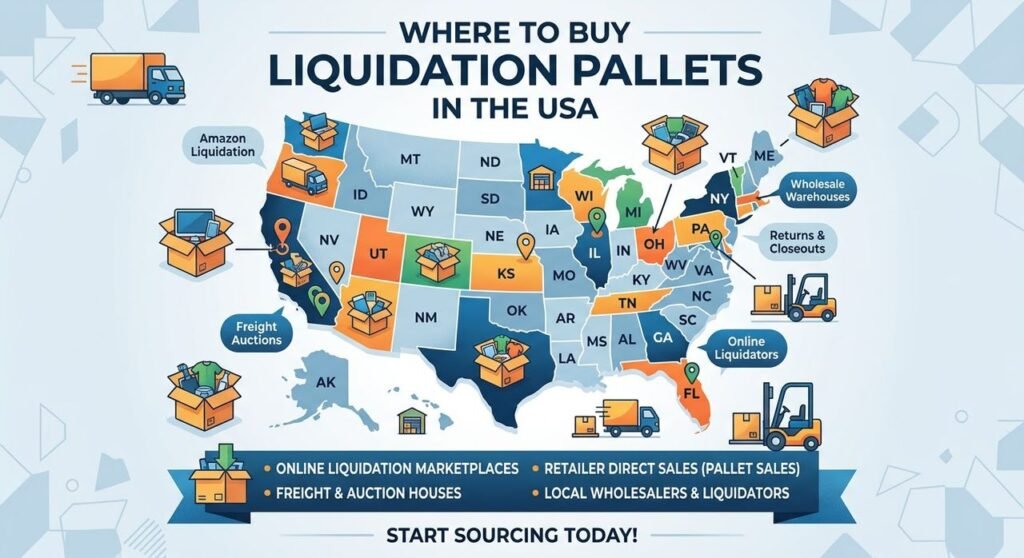
There isn’t just one place to purchase liquidation inventory. Buyers can source pallets through online liquidation suppliers, liquidation marketplaces, local warehouses, retailer-specific inventory channels, auctions, and wholesale suppliers.
Each option has advantages and disadvantages, so the best choice depends on what you’re trying to accomplish.
1. Buy Directly From a Liquidation Supplier
One of the simplest approaches is purchasing directly from a liquidation supplier that sells wholesale pallets.
Direct suppliers can offer different categories of inventory, allowing buyers to select merchandise based on their resale business.
For example, you may be able to find:
- Amazon liquidation pallets
- Walmart liquidation pallets
- Electronics pallets
- Clothing liquidation pallets
- Tool pallets
- General merchandise pallets
- Health and beauty inventory
- Sporting and outdoor merchandise
Buying from a supplier can also make the process easier because you can compare available inventory and choose a pallet rather than bidding against other buyers.
Before placing an order, however, always review the product description, condition information, quantity estimates, shipping terms, and any applicable policies.
2. Online Liquidation Marketplaces
Another way to buy liquidation pallets is through online liquidation marketplaces and auction platforms.
These platforms may list inventory from different retailers, brands, distributors, and liquidation sources.
The advantage is variety. You can compare different lots and potentially find inventory that matches your business model.
The disadvantage is that the buying process can require more research. Some lots may be auction-based, while others may have fixed prices. Buyers should also understand buyer fees, freight charges, manifests, condition descriptions, and pickup or delivery requirements before purchasing.
3. Retailer-Specific Liquidation Pallets
Some buyers prefer inventory associated with a particular retailer because they already understand the types of products customers expect from that retailer.
For example, you can focus your sourcing strategy around Amazon, Walmart, electronics retailers, clothing retailers, or other major retail categories.
For buyers interested in Amazon inventory, you can explore our Amazon liquidation pallets.
Walmart-focused buyers can also explore our Walmart liquidation pallets.
Retailer-specific sourcing can make inventory selection easier, but you should still evaluate the actual pallet rather than assuming every lot will have the same products or condition.
4. Local Liquidation Warehouses
If you search for liquidation pallets near me, you may find local warehouses and wholesale liquidation businesses in your area.
Buying locally can have one major advantage: you may be able to inspect inventory before purchasing, depending on the supplier’s policies.
Local pickup can also reduce or eliminate certain freight expenses, although this depends on the supplier and distance.
However, local inventory can be limited. A warehouse near you may not consistently have the category or volume you need.
What Types of Liquidation Pallets Can You Buy?
The best liquidation pallet depends heavily on what you plan to resell and who your customers are.
Amazon Liquidation Pallets
Amazon liquidation inventory can include a broad mixture of merchandise. Depending on the lot, buyers may encounter electronics, household goods, clothing, toys, tools, kitchen products, and general merchandise.
Our Amazon Pallets category is a useful starting point for buyers specifically looking for Amazon-related inventory.
Walmart Liquidation Pallets
Walmart-related liquidation inventory can cover many consumer categories, making it potentially suitable for general merchandise resellers.
Browse our Walmart Pallets selection if this type of inventory fits your business.
Electronics Pallets
Electronics are popular among resellers because individual products can often be sold through online marketplaces, local sales, specialty stores, or other channels.
However, electronics require careful evaluation because condition can have a major effect on resale value.
For buyers interested in this category, see our mixed electronics pallets.
Clothing Liquidation Pallets
Clothing pallets can contain apparel in different sizes, styles, brands, and conditions. They can work particularly well for online sellers, flea market vendors, discount retailers, and boutique-style businesses.
Explore our clothing liquidation pallets if apparel is part of your resale strategy.
Tool Liquidation Pallets
Tools can be attractive to resellers because they have multiple potential customer groups, including contractors, homeowners, mechanics, tradespeople, and DIY customers.
For example, buyers can evaluate options such as Wholesale Echo Tool Pallets, DeWalt, Ryobi & Milwaukee pallets, and wholesale power tools.
Before buying a tool pallet, pay particular attention to condition, completeness, battery availability where applicable, and whether products are tested.
How to Choose a Liquidation Pallet Supplier
Finding a pallet for sale is easy. Finding the right supplier requires more research.
Before buying, evaluate the following factors:
- Inventory description: Understand what the pallet is supposed to contain.
- Condition: Determine whether products are new, overstock, customer returns, shelf pulls, used, tested, or untested.
- Quantity: Check estimated unit counts where available.
- Pricing: Compare the pallet price against your expected landed cost.
- Shipping: Understand whether freight is included or charged separately.
- Policies: Review cancellation, return, damage, and order policies.
- Supplier information: Look for clear business information and accessible customer support.
- Product photos: Use available photographs to understand the type of inventory being offered.
How Much Do Liquidation Pallets Cost?
There is no single price for a liquidation pallet.
Prices vary according to product category, quantity, condition, estimated retail value, brand mix, demand, shipping, and other factors.
A small general merchandise pallet may have a very different price from a pallet containing branded electronics or professional tools.
Instead of asking only, “How much does the pallet cost?”, calculate your landed cost.
A simple formula is:
Landed Cost = Pallet Price + Freight + Fees + Other Direct Costs
Then estimate your potential resale revenue and expenses before deciding whether the purchase makes sense.
For a detailed calculation method, read our guide on how to calculate liquidation pallet profit and ROI.
Should You Buy Customer Returns or Overstock?
This is an important question for new liquidation buyers.
Overstock generally refers to merchandise that was not sold through normal retail channels. Depending on the lot, products may be in new or retail-ready condition.
Customer returns are products that were previously purchased and then returned. Their condition can vary significantly.
Customer returns can provide opportunities, but they also require more inspection and potentially more work.
If you’re starting out, make sure your budget allows for damaged, incomplete, defective, or slower-moving products when applicable.
What Should You Check Before Buying?
Before you purchase a liquidation pallet, ask yourself these questions:
- Do I understand what type of inventory I’m buying?
- Do I know the condition of the products?
- Can I store the entire pallet?
- Do I have a realistic sales channel for the inventory?
- Have I calculated freight and other costs?
- Can I afford products that take longer to sell?
- Have I researched the demand for this category?
- Have I compared the supplier’s terms with other options?
Answering these questions before purchasing can prevent many of the common mistakes made by first-time liquidation buyers.
Where Should You Sell Liquidation Inventory?
Buying the inventory is only the first part of the business. Your resale strategy is equally important.
Depending on the merchandise, potential sales channels can include:
- eBay
- Facebook Marketplace
- Local marketplaces
- Flea markets
- Discount stores
- Bin stores
- Pop-up shops
- Your own ecommerce website
- Specialty stores
The right sales channel depends on the products you’re buying.
For example, tools may appeal to contractors and local buyers, while clothing may work well through online marketplaces, boutiques, flea markets, and social selling.
If you’re considering flea markets, read our guide to the best liquidation pallets to resell at flea markets.
How to Start Buying Liquidation Pallets as a Beginner
If you’re buying your first pallet, don’t feel pressured to start with the largest possible order.
Start with a category you understand.
For example, if you already know how to sell clothing, a clothing pallet may be easier to manage than an electronics pallet containing products you cannot test.
Likewise, someone with experience selling tools may be better positioned to evaluate a tool pallet.
Start by determining:
- Your available purchasing budget
- Your storage capacity
- Your preferred product category
- Your target customers
- Your preferred sales channels
- Your expected selling costs
- Your acceptable level of inventory risk
Then compare available pallets based on their total economics rather than simply choosing the cheapest pallet.
Common Mistakes When Buying Liquidation Pallets
New buyers often focus heavily on the potential retail value of a pallet without considering the work and costs required to convert that inventory into actual sales.
Some common mistakes include:
- Buying without understanding product condition
- Ignoring freight costs
- Assuming every item will sell quickly
- Failing to research demand
- Buying more inventory than they can store
- Using retail price as guaranteed resale value
- Failing to account for marketplace fees
- Buying products they don’t understand
A strong liquidation business is built around disciplined buying, realistic pricing, organized inventory management, and consistent selling.
Is Buying Liquidation Pallets Worth It?
Liquidation pallets can be a useful source of wholesale inventory for resellers and small businesses, but the economics vary from pallet to pallet.
The goal should not be to find a pallet that simply looks cheap. Instead, look for inventory that matches your customers, sales channels, available capital, storage space, and ability to process the merchandise.
Before purchasing, calculate your expected landed cost and create a realistic resale plan.
For a broader explanation of how the liquidation resale model works, read our guide to wholesale liquidation pallets for resale.
Frequently Asked Questions
Where is the best place to buy liquidation pallets?
The best source depends on your business. Online liquidation suppliers, marketplaces, local warehouses, and retailer-specific sources can all provide different types of inventory. Compare condition, price, shipping, product selection, and supplier policies before buying.
Can I buy liquidation pallets online?
Yes. Many liquidation suppliers and marketplaces sell pallets online. Online purchasing allows you to compare inventory from different sources, but you should carefully review the listing details, condition, shipping costs, and policies before placing an order.
Can I buy liquidation pallets near me?
Possibly. Local liquidation warehouses and wholesale suppliers may offer pickup options depending on your location. Searching for liquidation pallets near you can help identify local sources, but always verify inventory availability and purchasing requirements.
Are liquidation pallets good for beginners?
They can be, particularly when a beginner starts with a manageable quantity and a product category they understand. New buyers should research the inventory, calculate total costs, and have a plan for selling the products before purchasing.
What is the best liquidation pallet to buy?
There is no universal best pallet. The right choice depends on your customers, experience, budget, storage space, and preferred sales channel. Clothing, electronics, tools, general merchandise, and retailer-specific pallets can all suit different resale businesses.
Shop Liquidation Pallets
Once you’ve identified the type of inventory that fits your business, you can browse available wholesale inventory through our liquidation pallets and wholesale products.
Compare the product description, quantity, condition, pricing, and shipping information before placing your order.
If you’re still researching, visit our liquidation tips and guides for additional information about sourcing, evaluating, and reselling liquidation inventory.
Ready to source your next pallet? Explore the available inventory and choose a liquidation product that fits your resale strategy.