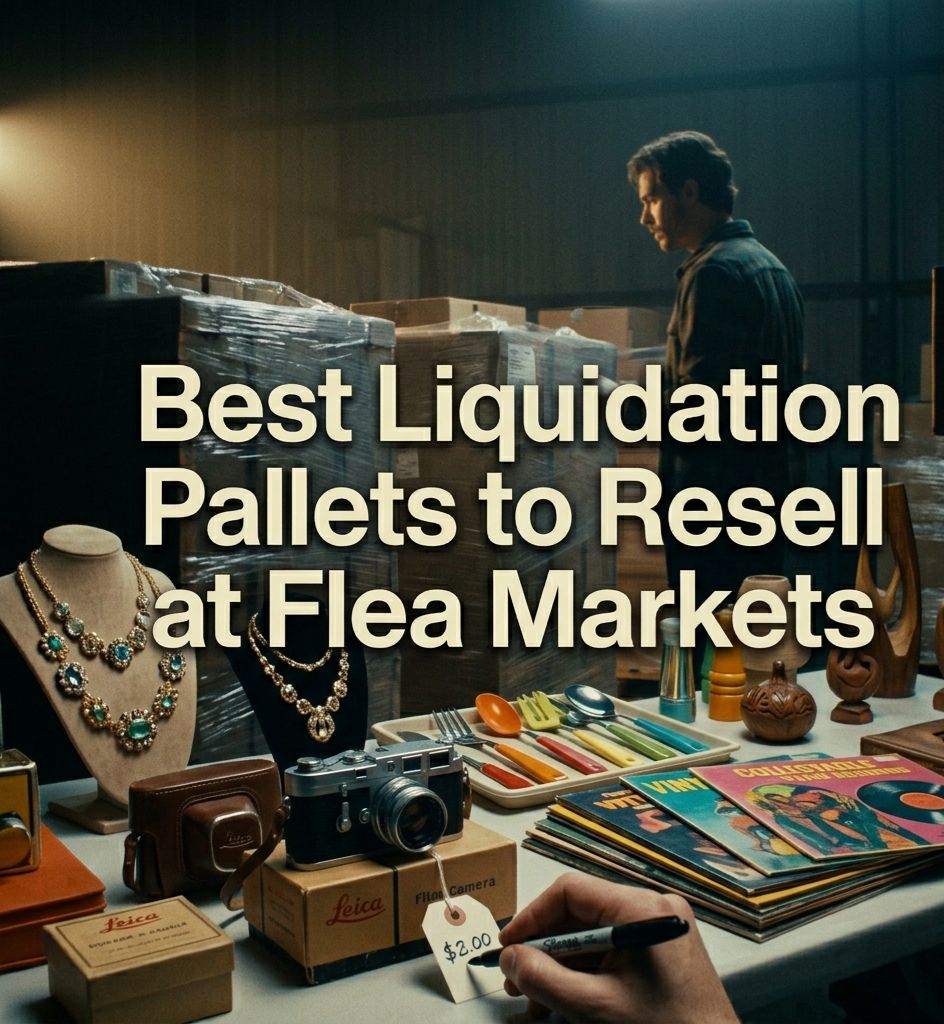
Best Liquidation Pallets to Resell at Flea Markets
Flea markets can be an attractive sales channel for liquidation resellers because customers can see, touch, compare, and purchase products directly. Unlike online selling, you don’t necessarily have to package and ship every individual item, making local selling particularly useful for bulky or lower-priced merchandise.
However, not every liquidation pallet is equally suitable for a flea market. The best inventory is usually merchandise that is easy to display, simple for customers to understand, reasonably priced, and in categories with demand in your local market.
In this guide, we’ll look at some of the best liquidation pallets for flea markets, how to choose inventory, how to price your products, and how to turn a pallet into an organized flea-market selling strategy.
What Makes a Good Flea Market Liquidation Pallet?
Before choosing a pallet, think about what makes products easy to sell in a physical market environment.
Good flea-market inventory often has several characteristics:
- Easy to display
- Easy for customers to understand
- Affordable price points
- Recognizable brands or product categories
- Products customers can inspect in person
- Potential for impulse purchases
- Enough variety to attract different buyers
Your local market matters too. What sells well at one flea market may perform differently at another location, so research your customers and competitors before committing to large quantities.
1. Clothing Liquidation Pallets
Clothing is one of the most flexible categories for flea-market sellers.
Apparel is relatively easy to display using clothing racks, tables, bins, and folding displays. Customers can inspect the material, check the size, and try products on when your setup allows it.
Depending on the pallet, clothing inventory can include:
- T-shirts
- Hoodies
- Jeans
- Jackets
- Sweatshirts
- Athletic apparel
- Children’s clothing
- Women’s clothing
- Men’s clothing
Clothing also gives you flexibility when pricing. You can have individual price points for premium pieces while using bundle deals for lower-priced items.
Explore our Clothing Liquidation Pallets.
How to Display Clothing
- Use racks for premium clothing.
- Fold basic products neatly on tables.
- Separate products by size.
- Use clear pricing signs.
- Place standout pieces near the front of your booth.
2. Footwear Liquidation Pallets
Shoes and footwear can be excellent flea-market inventory because customers can physically inspect the product before buying.
Popular footwear categories can include sneakers, boots, sandals, casual shoes, and other styles depending on the pallet.
Brand recognition can also help customers make purchasing decisions, but sellers should accurately represent the brand, condition, size, and authenticity of every item.
For example, our Crocs liquidation pallets are positioned for resellers, including flea-market vendors. The current product listing describes approximately 120 pairs per pallet, although inventory quantities can change. :contentReference[oaicite:1]{index=1}
For footwear, organize your display by size and clearly mark prices so customers don’t have to ask about every pair.
3. Electronics Liquidation Pallets
Electronics can attract significant attention at flea markets because customers often want to inspect products before purchasing.
Possible electronics inventory can include:
- Consumer electronics
- Accessories
- Small electronic devices
- Computer accessories
- Gaming-related products
- Small appliances
Electronics require more preparation than some other categories.
Before taking electronics to a flea market, inspect and test products whenever possible. Clearly separate tested products from items that require repair or further inspection.
Explore our Electronics Liquidation Pallets.
4. Tool Liquidation Pallets
Tools can be particularly interesting for flea-market sellers because buyers often visit markets specifically looking for affordable equipment.
Depending on the pallet, you may find:
- Hand tools
- Power tools
- Lawn equipment
- Workshop accessories
- Hardware
- Tool accessories
Tools are especially suitable for local sales when shipping individual items would be expensive or inconvenient.
For example, our Echo tool pallet listing specifically identifies flea-market vendors among its target buyers. The listing also explains that the inventory can include mixed conditions, so sellers should inspect and sort the merchandise before offering it to customers. :contentReference[oaicite:2]{index=2}
See our Tools Liquidation Pallets if this category fits your market.
5. Perfume and Fragrance Pallets
Fragrance products can work well in physical retail environments because customers can examine the packaging and, where appropriate, sample products.
However, fragrance sellers should pay close attention to authenticity, packaging, expiration information where applicable, and applicable marketplace or local selling requirements.
Our current perfume pallet listing describes a large mixed-fragrance lot and specifically identifies flea-market and swap-meet vendors as potential buyers. The listing also notes that the exact brand mix can vary by lot. :contentReference[oaicite:3]{index=3}
Explore our Perfume Liquidation Pallets.
6. Health and Beauty Liquidation Pallets
Health and beauty products can provide a wide variety of small items that are easy to display on tables and shelves.
Depending on the inventory source, this category can include:
- Cosmetics
- Skincare products
- Beauty accessories
- Personal-care products
- Hair-care products
- Grooming products
Check product condition, packaging, dates where relevant, and applicable regulations before selling health and beauty merchandise.
Browse our Health & Beauty Liquidation Pallets.
7. General Merchandise Pallets
If you want variety at your flea-market booth, general merchandise pallets can be worth considering.
Instead of focusing on one product category, general merchandise can provide a mixture of products that allows you to create different price points and attract different customers.
Possible products can include:
- Home goods
- Kitchen products
- Small appliances
- Household products
- Toys
- Accessories
- Seasonal merchandise
The advantage is variety, but the trade-off is that you need an efficient sorting and pricing system.
Explore our General Merchandise Pallets.
8. Amazon Liquidation Pallets
Amazon liquidation pallets can be attractive to flea-market sellers who want a broader assortment of merchandise.
Depending on the particular pallet, inventory can include different retail categories, which can give you multiple products to display at one market.
Our Amazon Liquidation Pallets category includes different pallet options designed around various merchandise types.
For a flea-market seller, the key is to sort the pallet before your market day and group similar products together.
9. Walmart Liquidation Pallets
Walmart liquidation pallets can also provide a diverse selection of merchandise depending on the specific pallet.
This variety can be useful if your flea-market customers have different interests and price ranges.
Browse our Walmart Liquidation Pallets.
10. Target Liquidation Pallets
Target liquidation pallets can provide another option for sellers looking for retail merchandise across different categories.
As with any liquidation purchase, evaluate the specific pallet description, condition, quantity, pricing, and shipping costs before purchasing.
Explore our Target Liquidation Pallets.
How to Choose the Right Pallet for Your Flea Market
The best pallet isn’t necessarily the one with the highest advertised retail value.
Instead, consider your actual customers.
Look at Your Customer Demographics
Think about who visits your flea market.
Are they primarily looking for:
- Affordable clothing?
- Tools?
- Home goods?
- Electronics?
- Beauty products?
- Shoes?
- Children’s products?
Understanding your customers can help you choose inventory with a better chance of fitting your market.
Consider Your Price Points
Flea-market customers often have different budgets.
Consider creating several price ranges rather than putting all your inventory into one price category.
For example, you might have:
- Low-cost impulse items
- Mid-priced products
- Premium or branded products
This gives different customers a reason to stop at your booth.
Consider Product Size
Your vehicle, booth size, storage, and transportation costs all matter.
Smaller products may allow you to bring a larger assortment to each market, while bulky products may require more transportation space.
How to Price Liquidation Inventory at a Flea Market
Pricing is one of the most important parts of flea-market reselling.
Don’t simply take the original retail price and reduce it by a fixed percentage.
Instead, consider:
- Your total acquisition cost
- Current market prices
- Product condition
- Local competition
- Customer demand
- How much inventory you need to move
- Your desired margin
Use Clear Price Tags
Customers are more likely to engage with your products when prices are immediately visible.
Use large, easy-to-read signs.
Offer Bundles
Bundle pricing can encourage customers to purchase multiple products.
Examples include:
- Buy 2, save $X
- 3 for $X
- Buy one, get the second at a discount
Make sure your bundle prices still cover your costs.
How to Set Up a Flea Market Liquidation Booth
Your display can make a major difference in how much attention your inventory receives.
Put Your Best Products at the Front
Use attractive or recognizable products to encourage people to stop.
Use Vertical Displays
Clothing racks and vertical displays can help customers see products from farther away.
Keep Prices Visible
Don’t make customers ask for every price.
Organize by Category
Group similar products together so customers can quickly find what they want.
Keep the Booth Clean
A clean, organized booth can make inexpensive merchandise look significantly more appealing.
Should You Sell Liquidation Pallets Online or at Flea Markets?
You don’t necessarily have to choose only one sales channel.
Different products can be suited to different channels.
| Flea Market | Online Selling |
|---|---|
| Direct customer interaction | Larger potential customer reach |
| No individual shipping for local sales | Convenient for smaller products |
| Customers can inspect products | Products can be listed 24/7 |
| Good for impulse purchases | Useful for specialized products |
| Requires transportation and booth setup | Requires packaging and shipping |
Some resellers use both strategies. They may sell suitable products at flea markets while listing higher-value or specialized products online.
Common Flea Market Liquidation Reselling Mistakes
Buying Without Knowing Your Customer
Don’t assume a product will sell simply because it has a high retail price.
Ignoring Condition
Returned and open-box products should be inspected before being presented to customers.
Overpaying for Inventory
Calculate your complete landed cost before purchasing.
Bringing Too Much Inventory
Start with quantities you can realistically transport, display, and manage.
Not Tracking Sales
Track what sells and what doesn’t. Over time, your sales records can tell you which pallet categories are worth buying again.
How to Turn Flea Market Sales Into a Repeatable Business
Successful liquidation reselling is easier when you treat it as a business rather than a one-time opportunity.
Track:
- Pallet purchase price
- Freight costs
- Booth fees
- Transportation
- Sales revenue
- Unsold inventory
- Average transaction value
- Best-selling categories
After several markets, you can compare your results and determine which inventory categories provide the best combination of demand, margins, and sell-through for your particular market.
Frequently Asked Questions
What are the best liquidation pallets for flea markets?
Popular options can include clothing, footwear, tools, electronics, beauty products, general merchandise, and other consumer goods. The best choice depends on your local customers and selling environment.
Can I make money selling liquidation pallets at flea markets?
Flea-market reselling can provide profit opportunities, but profitability isn’t guaranteed. Your results depend on inventory cost, freight, booth fees, product condition, local demand, pricing, and sell-through.
Are clothing pallets good for flea markets?
Clothing can be well suited to flea markets because it is relatively easy to display, customers can inspect products in person, and sellers can offer different price points.
Are electronics good for flea markets?
Electronics can attract buyers, but sellers should inspect and test products whenever possible and clearly communicate their condition.
Should I buy a mixed merchandise pallet?
Mixed merchandise can provide variety, but you should have a system for sorting, pricing, displaying, and selling different product categories.
How should I price liquidation products?
Consider your total acquisition cost, current market prices, product condition, local competition, customer demand, and desired margin. Avoid assuming that original retail price equals your actual resale value.
Ready to Source Inventory for Your Flea Market?
The right liquidation pallet can give your flea-market booth a wide selection of products and price points. But the key is choosing inventory that matches your customers rather than buying solely because a pallet appears inexpensive.
Start with a category you understand, calculate your complete cost, inspect the merchandise carefully, and track what sells at each market.
When you’re ready to source inventory, browse our liquidation pallets for sale.
You can also explore:
- Amazon Pallets
- Walmart Pallets
- Target Pallets
- Electronics Pallets
- Clothing Pallets
- General Merchandise Pallets
- Health & Beauty Pallets
Choose the category that fits your market, source your inventory carefully, and build your flea-market business one pallet at a time.