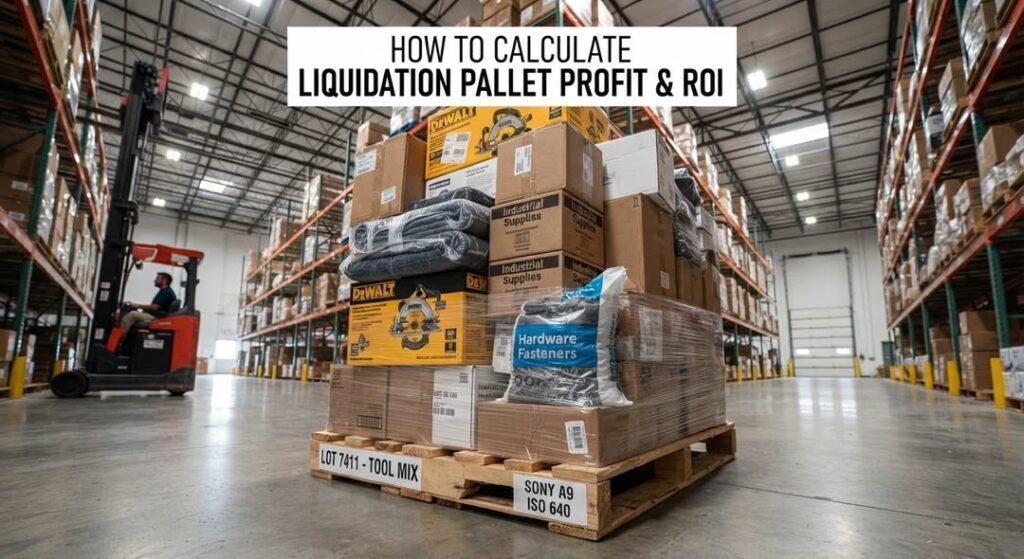
How to Calculate Liquidation Pallet Profit & ROI
Buying a liquidation pallet can look attractive when you see the number of products included or the estimated retail value. But the most important question for a reseller is not simply how much merchandise is inside the pallet.
The important question is:
How much money can I realistically make after all of my costs?
Understanding liquidation pallet profit requires more than subtracting the pallet purchase price from your expected sales. Freight, repairs, marketplace fees, storage, packaging, unsold merchandise, and other expenses can significantly affect your final result.
This guide explains how to calculate the potential profit and return on investment of a liquidation pallet before committing your money.
What Is Liquidation Pallet Profit?
Liquidation pallet profit is the amount remaining after you subtract the total cost of acquiring and selling the inventory from the revenue generated by your sales.
A simple formula is:
Profit = Sales Revenue − Total Costs
The difficult part is determining what should be included in “total costs.”
For a liquidation reseller, your costs can include:
- Pallet purchase price
- Freight
- Taxes or applicable acquisition costs
- Repairs
- Replacement parts
- Cleaning
- Packaging
- Marketplace fees
- Payment processing
- Advertising
- Storage
- Labor
- Booth fees
- Transportation
That’s why a pallet advertised with a high retail value should never automatically be treated as a guaranteed profit opportunity.
Step 1: Calculate Your Pallet Purchase Cost
Start with the amount you pay for the pallet itself.
For example:
Pallet purchase price: $1,200
That is only the beginning of your calculation.
Step 2: Add Freight and Shipping
Freight is one of the easiest costs for new resellers to overlook.
Suppose the pallet costs $1,200 and freight costs $350.
Your initial landed inventory cost becomes:
$1,200 + $350 = $1,550
So although the advertised pallet price is $1,200, your actual acquisition cost is $1,550.
Always calculate your potential return using the amount you actually have invested.
What Is Landed Cost?
Landed cost is the total amount you spend to acquire inventory and get it ready to enter your business.
A simple formula is:
Landed Cost = Purchase Price + Freight + Other Acquisition Costs
Depending on your situation, other acquisition costs could include applicable taxes, handling, transportation, or other charges.
Knowing your landed cost makes it much easier to compare different liquidation pallets.
Step 3: Estimate How Much Inventory Is Actually Sellable
This is particularly important when purchasing customer returns, open-box merchandise, or mixed-condition pallets.
Don’t assume that every unit will sell.
For example, imagine a pallet contains 100 pieces.
After inspection, you might determine that:
- 80 pieces are ready to sell
- 10 require minor preparation
- 5 require repair
- 5 aren’t economically worth reselling
Your actual sellable inventory is therefore different from the original quantity.
This is why you should evaluate the sellable inventory, not simply the number of pieces in the pallet.
Step 4: Estimate Your Realistic Selling Prices
The next step is estimating what customers are realistically willing to pay.
Don’t automatically use the original retail price.
A product that originally sold for $100 may have a current resale value of $60, $40, or less depending on:
- Condition
- Age
- Model
- Brand
- Market demand
- Competition
- Accessories
- Seasonality
Research comparable products and, where possible, look at actual completed sales rather than relying only on active asking prices.
Retail Value vs. Resale Value
These are two different numbers.
Retail value is generally associated with the original or current retail selling price.
Resale value is what you can realistically expect a customer to pay through your particular selling channel.
For liquidation resellers, resale value is the number that matters most when calculating potential revenue.
Step 5: Calculate Your Gross Revenue
Once you’ve estimated the realistic selling price of each product, add the expected sales together.
For example, imagine your pallet produces:
- 20 products at $50 = $1,000
- 30 products at $30 = $900
- 20 products at $20 = $400
- 10 products at $10 = $100
Your estimated gross revenue would be:
$1,000 + $900 + $400 + $100 = $2,400
Notice that this calculation only includes products you expect to sell.
It doesn’t assume that every piece of inventory will generate revenue.
Step 6: Subtract Your Total Costs
Now subtract your complete costs.
Suppose:
- Pallet = $1,200
- Freight = $350
- Repairs = $100
- Packaging = $50
- Marketplace/payment fees = $200
Total costs:
$1,200 + $350 + $100 + $50 + $200 = $1,900
If your actual sales revenue is $2,400:
$2,400 − $1,900 = $500 profit
Your estimated profit in this example would therefore be $500.
Step 7: Calculate Your Profit Margin
Profit margin shows how much of your sales revenue remains as profit.
The basic formula is:
Profit Margin = Profit ÷ Revenue × 100
Using the previous example:
$500 ÷ $2,400 × 100 = 20.8%
Your estimated profit margin would therefore be approximately 20.8%.
This is more useful than looking only at the dollar profit because it allows you to compare different inventory opportunities.
Step 8: Calculate Liquidation Pallet ROI
ROI stands for return on investment.
A simple ROI formula is:
ROI = Profit ÷ Investment × 100
If your total investment was $1,900 and your profit was $500:
$500 ÷ $1,900 × 100 = 26.3%
Your estimated ROI would therefore be approximately 26.3%.
Keep in mind that different businesses may calculate ROI differently depending on which operating expenses they include.
Why Sell-Through Rate Matters
One of the most important numbers in liquidation reselling is your sell-through rate.
Imagine you purchase 100 items but only sell 70 of them.
The 30 unsold products still represent money tied up in inventory.
Your business therefore needs to consider not just how much inventory can potentially be sold, but how quickly it can realistically be sold.
Fast-moving inventory can be valuable because it allows you to recover your capital and purchase another pallet sooner.
How to Calculate Break-Even Point
Your break-even point is the amount of sales revenue you need to generate to recover your costs.
For example, if your total investment is $2,000, you need to generate $2,000 in revenue simply to recover that investment.
Revenue above that point can contribute toward profit, assuming you’ve included all relevant costs in your calculation.
Example: Calculating a Hypothetical Pallet
Let’s put everything together.
Suppose a hypothetical pallet has:
- Purchase price: $1,500
- Freight: $400
- Preparation and repairs: $150
- Packaging: $75
- Other selling costs: $175
Your total costs are:
$1,500 + $400 + $150 + $75 + $175 = $2,300
After sorting and pricing the inventory, you estimate that realistic sales could total $3,200.
Your estimated profit would be:
$3,200 − $2,300 = $900
Your estimated profit margin would be:
$900 ÷ $3,200 × 100 = 28.1%
Your estimated ROI would be:
$900 ÷ $2,300 × 100 = 39.1%
These are hypothetical numbers. Your actual results will depend on the merchandise you purchase and the prices you ultimately receive.
How Product Condition Affects Profit
Condition can have a significant effect on resale value.
New Inventory
New merchandise in original packaging may be easier to present and sell, depending on the product.
Open-Box Inventory
Open-box merchandise can potentially sell at a discount to retail while still being attractive to customers.
Customer Returns
Customer-return inventory can require more inspection and preparation.
Damaged Inventory
Products with significant damage may have limited resale value or may not be worth processing.
When evaluating a pallet, always consider the condition mix.
How Repairs Affect Your Profit
Repairs can turn a potentially profitable item into an unprofitable one if the repair cost is too high.
For example, suppose you expect to sell a returned tool for $80.
If repairing it costs $60 and requires significant labor, the economics may not make sense.
On the other hand, a simple $5 repair might make the item worth selling.
This is why resellers should evaluate repairs on an item-by-item basis.
How Selling Fees Affect Liquidation Profit
Online marketplaces and payment providers may charge transaction, listing, payment-processing, or other fees.
If you sell a product for $100 but pay $15 in combined fees and shipping-related costs, you don’t actually keep $100.
Include these expenses when estimating your net result.
How Shipping Affects Profit
Shipping can have a major impact on margins, particularly for heavy or bulky products.
A tool that sells for $100 may look attractive until you discover that shipping costs $30.
When evaluating products for online resale, consider:
- Product weight
- Package dimensions
- Shipping destination
- Packaging costs
- Carrier charges
For larger products, local selling may sometimes be more practical.
How Flea-Market Sellers Should Calculate Profit
If you sell liquidation inventory at flea markets, your calculation should include costs that online sellers may not have.
These can include:
- Booth fees
- Transportation
- Fuel
- Tables and displays
- Storage
- Payment processing
For more information, read our guide to the best liquidation pallets to resell at flea markets.
How to Compare Two Liquidation Pallets
Suppose you’re choosing between two pallets.
| Metric | Pallet A | Pallet B |
|---|---|---|
| Purchase price | $1,000 | $1,500 |
| Freight | $300 | $350 |
| Total investment | $1,300 | $1,850 |
| Estimated revenue | $1,900 | $2,900 |
| Estimated profit | $600 | $1,050 |
Pallet B costs more, but it may produce a larger dollar profit.
However, you should also compare ROI, sell-through rate, processing requirements, storage, and how quickly the inventory is expected to sell.
The cheapest pallet isn’t automatically the best opportunity.
Which Liquidation Categories Can Have Good Resale Potential?
Different categories can work for different businesses.
Electronics
Electronics can have established resale markets but may require testing and careful condition assessment.
Explore our Electronics Liquidation Pallets.
Clothing
Clothing can offer a variety of price points and selling channels.
Explore our Clothing Liquidation Pallets.
Tools
Tools can appeal to contractors, homeowners, mechanics, and DIY customers.
Browse our Tools Liquidation Pallets.
General Merchandise
General merchandise provides variety but can require more sorting and organization.
Explore our General Merchandise Pallets.
Amazon and Walmart Inventory
Retail liquidation pallets can provide access to multiple consumer categories.
Browse our Amazon Pallets and Walmart Pallets.
How to Improve Your Liquidation Pallet Margins
Buy Based on Data
Track the results of every pallet you purchase.
Record:
- Total investment
- Number of sellable products
- Revenue
- Profit
- Sell-through rate
- Average selling price
- Time required to sell
Reduce Processing Costs
Develop a consistent process for sorting, testing, photographing, listing, and packaging products.
Choose the Right Sales Channel
Some products may perform better locally while others are better suited to online marketplaces.
Buy Inventory Your Customers Already Want
Existing customer demand is often more valuable than an attractive theoretical retail value.
Should You Buy a Liquidation Pallet Based on ROI?
ROI is useful, but it shouldn’t be the only metric you consider.
A pallet with a high theoretical ROI may require months to sell.
Another pallet may produce a lower percentage return but sell much faster.
Consider:
- ROI
- Dollar profit
- Sell-through rate
- Time to sell
- Storage requirements
- Processing costs
- Customer demand
For a growing business, the speed at which you recover your capital can be just as important as the theoretical margin.
Common Liquidation Profit Calculation Mistakes
Using Retail Value as Revenue
Retail value doesn’t guarantee your actual selling price.
Ignoring Freight
Freight should be included in your acquisition cost.
Ignoring Unsold Inventory
Not every item will necessarily sell.
Ignoring Marketplace Fees
Fees reduce your actual revenue.
Ignoring Repairs
Returned products can require additional investment.
Ignoring Your Time
Your time has value. If a pallet requires extensive testing and repair, include that consideration in your evaluation.
Liquidation Pallet Profit Calculator Formula
You can use the following basic formulas to evaluate a pallet:
Total Investment = Pallet Cost + Freight + Preparation Costs + Other Costs
Gross Profit = Sales Revenue − Total Investment
Profit Margin = Gross Profit ÷ Sales Revenue × 100
ROI = Gross Profit ÷ Total Investment × 100
These formulas provide a starting point. Your accounting method may include additional business expenses depending on your operation.
Frequently Asked Questions
How do I calculate liquidation pallet profit?
Subtract your complete acquisition and selling costs from your actual sales revenue. Include pallet cost, freight, repairs, packaging, fees, storage, labor, and other relevant expenses.
What is a good ROI for liquidation pallets?
There is no universal ROI that guarantees a good investment. Compare expected ROI with sell-through rate, time to sell, operating costs, and the amount of capital required.
Should I use retail value when calculating pallet profit?
No. Retail value can provide context, but realistic resale prices are more useful for calculating potential revenue.
Do customer-return pallets have lower profit margins?
Not necessarily. However, customer returns can require more inspection, repairs, cleaning, or missing accessories, which can increase processing costs.
Does freight affect liquidation pallet profit?
Yes. Freight increases your landed cost and should be included when calculating potential profit and ROI.
How can I increase liquidation pallet profits?
Focus on accurate purchasing decisions, realistic resale prices, efficient processing, appropriate selling channels, and products that match your customers’ demand.
Ready to Calculate Your Next Pallet?
Before purchasing liquidation inventory, calculate the complete cost and estimate realistic resale revenue.
Don’t base your decision only on the pallet’s advertised retail value. Consider product condition, freight, sellable units, current market prices, fees, repairs, storage, and your expected sell-through rate.
When you’re ready to source inventory, browse our Liquidation Pallets for Sale.
You can also explore:
- Amazon Pallets
- Walmart Pallets
- Electronics Pallets
- Clothing Pallets
- Tools Liquidation Pallets
- General Merchandise Pallets
The best liquidation purchase isn’t necessarily the pallet with the highest advertised retail value. It’s the inventory you can acquire at a realistic cost, sell through efficiently, and turn into a sustainable return for your business.