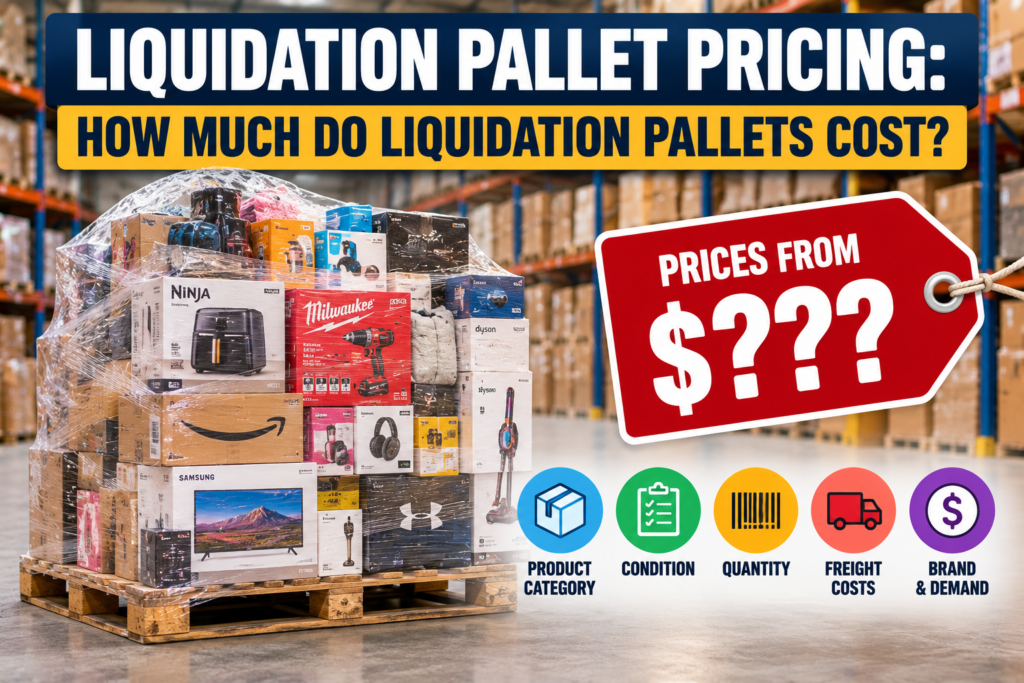
Liquidation Pallet Prices: How Much Do Liquidation Pallets Cost?
If you are considering buying liquidation inventory, one of the first questions you will probably ask is: how much do liquidation pallets cost?
There is no single price that applies to every liquidation pallet. The cost can vary significantly depending on the product category, inventory condition, quantity, brand mix, source, pallet size, location and shipping costs.
Understanding liquidation pallet prices is important because the advertised purchase price is only one part of your total investment. Freight, handling, marketplace fees, repairs, testing and other expenses can affect your final cost and potential resale margin.
This guide explains the factors that influence liquidation pallet pricing and what to check before purchasing inventory.
How Much Do Liquidation Pallets Cost?
Liquidation pallets can range from relatively inexpensive mixed merchandise lots to substantially more expensive pallets containing higher-value or branded inventory.
Because inventory differs from pallet to pallet, it is more useful to evaluate the individual lot rather than assuming that every pallet in a category should cost the same amount.
For example, two electronics pallets may have completely different values depending on the products, quantities and condition inside each pallet.
The same applies to clothing, tools, general merchandise and customer-return pallets.
Before comparing prices, determine exactly what is included in the pallet and what additional costs you will have to pay.
What Determines Liquidation Pallet Prices?
Several factors can influence the price of liquidation inventory.
1. Product Category
The category of merchandise is one of the first things to consider.
Electronics, tools, clothing, health and beauty, home improvement and general merchandise can all have different pricing structures.
Products with higher individual resale values may command higher pallet prices, but buyers should still evaluate the actual inventory rather than assuming that a higher purchase price automatically means better resale results.
2. Product Condition
Condition can have a major effect on liquidation pallet pricing.
Inventory may include:
- New merchandise
- Overstock
- Shelf pulls
- Open-box products
- Customer returns
- Used merchandise
- Refurbished products
- Salvage inventory
- Mixed-condition merchandise
A pallet containing new overstock merchandise may have different economics from a customer-return pallet where individual products require inspection or testing.
Read our guide to liquidation pallet condition grades before comparing different lots.
3. Quantity of Merchandise
The number of units in a pallet also matters.
A pallet containing a large number of lower-cost products should not automatically be compared with a pallet containing fewer high-value products.
Instead, calculate the approximate cost per unit whenever reliable quantity information is available.
For example:
Cost Per Unit = Total Inventory Cost ÷ Number of Units
This gives you another way to compare different lots.
4. Brand and Product Mix
Brand composition can affect the resale potential of a pallet.
A pallet containing recognizable brands may attract different buyers than an unbranded mixed-merchandise pallet.
However, brand names alone should not determine what you pay. Check the actual products, condition and current resale demand.
5. Source of the Inventory
Liquidation merchandise can originate from different channels, including retailer returns, excess inventory, overstock, discontinued merchandise and other surplus inventory.
The source can affect both the composition and condition of the merchandise.
Ask the supplier what type of inventory you are purchasing and whether the pallet is manifested, partially manifested or sold as an assorted lot.
Don’t Forget Freight When Calculating Pallet Cost
One of the most common mistakes new buyers make is looking only at the pallet purchase price.
Your actual investment may be higher once transportation and other direct costs are included.
A simple calculation is:
Total Landed Cost = Pallet Price + Freight + Other Direct Purchasing Costs
For example, imagine a hypothetical pallet costs $800 and freight costs $250.
Your inventory cost before other expenses would be:
$800 + $250 = $1,050
If the pallet contains 100 units, the average landed cost would be:
$1,050 ÷ 100 = $10.50 per unit
This does not mean every item is worth exactly $10.50. It simply gives you a useful average when evaluating the overall lot.
Purchase Price vs. Resale Value
Do not confuse the purchase price of a liquidation pallet with the potential resale value of the merchandise.
A pallet may contain products with a combined original retail value that is much higher than the liquidation purchase price. However, that does not mean you will sell every product at its original retail price.
Your actual selling prices may be affected by:
- Product condition
- Market demand
- Competition
- Seasonality
- Marketplace fees
- Shipping to your customers
- Discounts
- Returns
- Unsold inventory
For this reason, evaluate liquidation inventory using realistic resale prices rather than advertised retail values alone.
How to Calculate Your Potential Liquidation Pallet Profit
Once you know the total landed cost, you can estimate the potential economics of the inventory.
A basic calculation is:
Gross Profit = Sales Revenue − Total Cost
For example, suppose a hypothetical pallet has:
- Pallet purchase price: $1,000
- Freight: $250
- Other direct costs: $50
- Total landed cost: $1,300
If the inventory eventually generates $2,000 in sales revenue, the gross profit before other operating expenses would be:
$2,000 − $1,300 = $700
This is only an example. Actual results depend on the products, selling prices, expenses and sell-through rate.
Use our complete guide to calculating liquidation pallet profit and ROI for a more detailed breakdown.
Liquidation Pallet Prices by Category
Instead of looking for one universal pallet price, compare inventory within the same category.
Electronics Liquidation Pallets
Electronics pallets can contain products such as consumer electronics, accessories and other technology-related merchandise.
Condition is particularly important because returned electronics may require testing before resale.
See our mixed electronics pallets for an example of category-specific liquidation inventory.
Clothing Liquidation Pallets
Clothing pallets may contain assorted apparel, garments, footwear or other fashion merchandise.
When evaluating clothing inventory, consider size distribution, seasonality, brand mix, condition and the sales channels you plan to use.
Browse our clothing liquidation pallets.
Tool Liquidation Pallets
Tool pallets can include power tools, hand tools and equipment from different brands.
For used or returned tools, testing and condition can have a significant effect on resale value.
Examples include our wholesale power tools and DeWalt, Ryobi and Milwaukee pallet.
Amazon Liquidation Pallets
Amazon-related liquidation inventory can include different types of merchandise depending on the specific lot and supplier.
Buyers should carefully review the description and condition information rather than assuming that every pallet contains the same product mix.
Explore our Amazon pallets category.
Walmart Liquidation Pallets
Walmart-related liquidation inventory can also vary by category and lot.
Review the product information, quantity, condition and purchasing terms before comparing one pallet with another.
See our Walmart pallets category.
How to Compare Two Liquidation Pallets
Suppose you are comparing two pallets.
Pallet A:
- Purchase price: $900
- Freight: $250
- Estimated units: 100
Pallet B:
- Purchase price: $1,100
- Freight: $200
- Estimated units: 150
Pallet A has a total direct cost of $1,150.
Pallet B has a total direct cost of $1,300.
Although Pallet B costs more overall, it contains more units. The next step would be to examine the condition, product mix and realistic resale values rather than choosing solely based on the lower purchase price.
This illustrates why comparing liquidation pallet prices requires more than looking at the headline price.
Questions to Ask Before Buying a Liquidation Pallet
Before placing an order, consider asking the supplier:
- What type of inventory is included?
- What is the expected condition?
- How many units are included?
- Is the pallet manifested?
- Are quantities estimates or confirmed?
- What products or categories are included?
- Are there known damaged or incomplete items?
- What is the freight cost?
- Are returns permitted?
- What payment methods are accepted?
- Where is the inventory shipping from?
Getting clear answers to these questions can make it easier to compare suppliers and calculate your actual acquisition cost.
Should You Buy a Cheap Liquidation Pallet?
A low advertised price can be attractive, but price alone should not determine whether a pallet is suitable for your business.
A cheap pallet can still become expensive if a large percentage of the merchandise is difficult to sell, requires significant repair, takes up storage space or generates little demand.
Instead of asking only, “How cheap is this pallet?”, ask:
- What am I actually receiving?
- What condition is it in?
- What is my total landed cost?
- Who will buy these products?
- Where will I sell them?
- What are realistic selling prices?
- How much work will the inventory require?
- What happens to products that do not sell?
Buying Your First Liquidation Pallet
If you are new to liquidation inventory, consider starting with an amount of merchandise that you can realistically inspect, store, list and sell.
Choose a category you understand and research comparable products before buying.
Our guide to liquidation pallets for beginners explains the process from choosing inventory through resale.
You can also read our guide on where to buy liquidation pallets in the USA when comparing suppliers and purchasing options.
Frequently Asked Questions
How much is an average liquidation pallet?
There is no single average price that accurately represents every liquidation pallet. Prices vary according to category, condition, quantity, product mix, source and freight. Compare individual lots based on their actual contents and total landed cost.
Why are some liquidation pallets more expensive than others?
Differences in product category, condition, brands, quantities, inventory source and estimated resale value can all affect pricing.
Does a higher pallet price mean better inventory?
Not necessarily. A higher price may reflect a different product mix, quantity or condition. Evaluate the actual inventory and your expected resale economics.
Does liquidation pallet pricing include shipping?
Not always. Shipping and freight policies vary by supplier and product. Confirm the freight cost before calculating your total investment.
How do I know if a liquidation pallet is worth buying?
Compare the total landed cost with realistic resale prices, expected sell-through, fees, handling requirements and the risk of unsold or damaged inventory.
Final Thoughts
Liquidation pallet prices can vary widely, which is why buyers should evaluate the complete economics of each lot rather than relying on the advertised purchase price alone.
Consider the inventory condition, product mix, quantity, freight, resale demand, selling fees and the amount of work required to turn the merchandise into sales.
Whether you are looking for electronics, clothing, tools, general merchandise or retailer-specific liquidation inventory, understanding your total cost before buying can help you make a more informed purchasing decision.
When you are ready to explore available inventory, visit the Pallet Liquidation Mart shop to browse current liquidation products.