If you have ever searched for wholesale inventory, you have probably come across the term liquidation pallets. But what exactly is pallet liquidation, where does the merchandise come from, and why do businesses buy it?
Pallet liquidation is the process of selling bulk quantities of merchandise through liquidation channels instead of traditional retail distribution. The inventory may include customer returns, overstock, shelf pulls, excess merchandise, discontinued products, seasonal inventory, or other products that a retailer or supplier wants to move.
For resellers, small retailers, online sellers, flea market vendors, discount stores, and entrepreneurs, liquidation pallets can provide a way to purchase merchandise in bulk and resell individual products through different sales channels.
However, liquidation inventory is different from traditional wholesale inventory. Product condition, quantity, assortment, and resale value can vary depending on the source and the specific pallet.
This guide explains what pallet liquidation is, how it works, the different types of liquidation inventory, what you may find inside a pallet, and what buyers should understand before purchasing.
What Is Pallet Liquidation?
Pallet liquidation refers to the sale of merchandise in bulk through liquidation or secondary-market channels. Instead of selling products individually through a traditional retail store, inventory is grouped into pallets or larger lots and sold to businesses, resellers, and other buyers.
A liquidation pallet can contain products from a single category or a mixture of different categories.
For example, a pallet may contain:
- Electronics
- Clothing
- Tools
- Home goods
- Beauty products
- Toys
- Kitchen products
- General merchandise
- Seasonal products
The exact contents depend on the source, category, inventory availability, and condition of the merchandise.
Why Does Liquidation Inventory Exist?
Retailers and suppliers regularly need to move inventory that is no longer required for their normal sales channels.
There are many reasons merchandise can enter liquidation channels.
Customer Returns
Customers sometimes return products after purchasing them. Depending on the retailer’s return process, those products may be inspected, restocked, refurbished, resold through another channel, or moved into liquidation inventory.
Customer return pallets can therefore contain products in different conditions.
Overstock Inventory
Overstock refers to merchandise that exceeds the quantity a retailer currently needs.
Retailers may liquidate excess inventory to free warehouse space, reduce carrying costs, or make room for new products.
Shelf Pulls
Shelf pulls are products removed from retail shelves. They may have been displayed in stores or handled by customers and employees.
The condition of shelf-pull merchandise can vary, so buyers should review the supplier’s condition information before purchasing.
Seasonal Inventory
Retailers often carry products that are strongly associated with a particular season or holiday.
When the selling season ends, some remaining inventory may be moved through liquidation channels.
Discontinued Products
Products that are discontinued or replaced by newer versions may also enter liquidation channels.
Excess or Closeout Merchandise
Businesses may liquidate merchandise that is no longer part of their regular inventory strategy.
What Can Be Found Inside a Liquidation Pallet?
There is no universal list of products inside a liquidation pallet. The contents depend on the category and source.
Some pallets are highly specialized, while others contain mixed merchandise.
Electronics Pallets
Electronics pallets may contain products such as consumer electronics, accessories, small appliances, computer-related products, and other electronic merchandise.
If you are interested in this category, you can explore our Electronics Pallets.
Clothing Pallets
Clothing liquidation pallets can contain apparel and related merchandise. Depending on the source, buyers may find different brands, sizes, styles, seasons, and product types.
See our Clothing Pallets category for available inventory.
General Merchandise Pallets
General merchandise pallets are designed around a broader assortment of products rather than one specific category.
This type of inventory can appeal to resellers who sell through multiple channels and want product variety.
Explore our General Merchandise Pallets.
Amazon Pallets
Amazon liquidation pallets may contain merchandise associated with Amazon liquidation inventory, including returns, overstock, and other excess products depending on the specific lot.
See our Amazon Pallets category for available products.
Walmart Pallets
Walmart liquidation pallets can contain merchandise across different retail categories depending on the specific pallet.
Explore our Walmart Pallets category.
Target Pallets
Target liquidation pallets can provide access to a variety of retail merchandise depending on the inventory source and pallet type.
Browse our Target Pallets category.
Health & Beauty Pallets
Health and beauty liquidation inventory can include cosmetics, personal care products, skincare items, beauty accessories, grooming products, and other consumer products.
Browse our Health & Beauty Pallets category.
What Are the Different Types of Liquidation Pallets?
Liquidation pallets can be classified according to their source, product category, condition, or assortment.
Customer Return Pallets
Customer return pallets contain products that have previously been purchased and returned. Condition can vary considerably, making inspection and careful evaluation important.
Overstock Pallets
Overstock pallets contain excess merchandise that a retailer or supplier needs to move.
Depending on the source, overstock products may be unused, but buyers should always verify the stated condition.
Mixed Merchandise Pallets
Mixed merchandise pallets contain products from multiple categories.
They can be useful for resellers who operate several sales channels or serve customers looking for different types of products.
Category-Specific Pallets
Category-specific pallets focus on one type of merchandise, such as electronics, clothing, tools, or health and beauty products.
These pallets can make inventory management easier because the buyer is purchasing products within an area they already understand.
What Does Pallet Condition Mean?
One of the most important things to understand about liquidation inventory is that condition can vary.
Common condition descriptions may include:
- New
- Like new
- Open box
- Customer returns
- Used
- Damaged packaging
- Mixed condition
The exact meaning of a condition description can vary between suppliers, so buyers should always review the supplier’s terms and ask questions when necessary.
What Is a Liquidation Manifest?
A liquidation manifest is an inventory list associated with a liquidation lot.
Depending on the supplier and type of inventory, a manifest may include information such as:
- Product descriptions
- SKU numbers
- Quantities
- Product categories
- Estimated retail values
- Model numbers
- Condition information
A manifest can make it easier for buyers to evaluate a pallet before purchasing.
However, buyers should not assume that an estimated retail value represents the amount they will actually receive when reselling the products.
Retail prices, market prices, product condition, marketplace fees, shipping, competition, and customer demand can all affect the final resale value.
Manifested vs. Unmanifested Liquidation Pallets
Manifested Pallets
A manifested pallet comes with some form of inventory information that helps buyers understand what may be included.
This can make the purchasing decision easier because you have more information to evaluate.
Unmanifested Pallets
An unmanifested pallet provides less detailed information about the exact contents.
Some buyers prefer the potential variety of unmanifested inventory, while others prefer having more information before committing their money.
Neither option is automatically better. The right choice depends on your risk tolerance, experience, purchasing strategy, and the information provided by the supplier.
How Is the Price of a Liquidation Pallet Determined?
Liquidation pallet prices can vary significantly.
Factors that may influence pricing include:
- Product category
- Quantity
- Condition
- Brand recognition
- Demand
- Estimated market value
- Availability
- Source
- Shipping requirements
A pallet with high-demand products may command a different price from a pallet containing slower-moving merchandise.
Buyers should compare the total acquisition cost with realistic resale expectations rather than judging a deal solely by the advertised retail value.
Liquidation Pallets vs. Traditional Wholesale
Liquidation and traditional wholesale are not exactly the same.
| Liquidation Pallets | Traditional Wholesale |
|---|---|
| May include returns or excess inventory | Typically focused on regular wholesale inventory |
| Condition can vary | Condition is generally more standardized |
| Product assortment may vary | Product selection is generally more predictable |
| Can provide access to discounted inventory | Usually follows established wholesale pricing |
| May require additional inspection | Usually easier to predict inventory condition |
Neither model is automatically better. The right sourcing strategy depends on your business model, budget, experience, and customers.
Who Buys Liquidation Pallets?
Liquidation inventory can be purchased by many different types of businesses and entrepreneurs.
- Online resellers
- eBay sellers
- Retail stores
- Discount stores
- Flea market vendors
- Bin stores
- Independent retailers
- Entrepreneurs
- Wholesale buyers
The most important factor is having a realistic plan for what you will do with the inventory after purchasing it.
Where Can You Sell Liquidation Inventory?
Once you purchase liquidation merchandise, you need a strategy for selling it.
Online Marketplaces
Online marketplaces can provide access to a large customer base. However, sellers should account for marketplace fees, shipping costs, returns, competition, and platform rules.
Local Marketplaces
Local marketplaces can be useful for larger products or merchandise that is expensive to ship.
Flea Markets
Flea markets can provide opportunities to sell a broad range of liquidation merchandise directly to consumers.
Physical Retail Stores
Retailers can use liquidation inventory as part of a discount or resale strategy depending on their business model and available inventory.
Are Liquidation Pallets Profitable?
Liquidation pallets can provide resale opportunities, but profitability is never guaranteed.
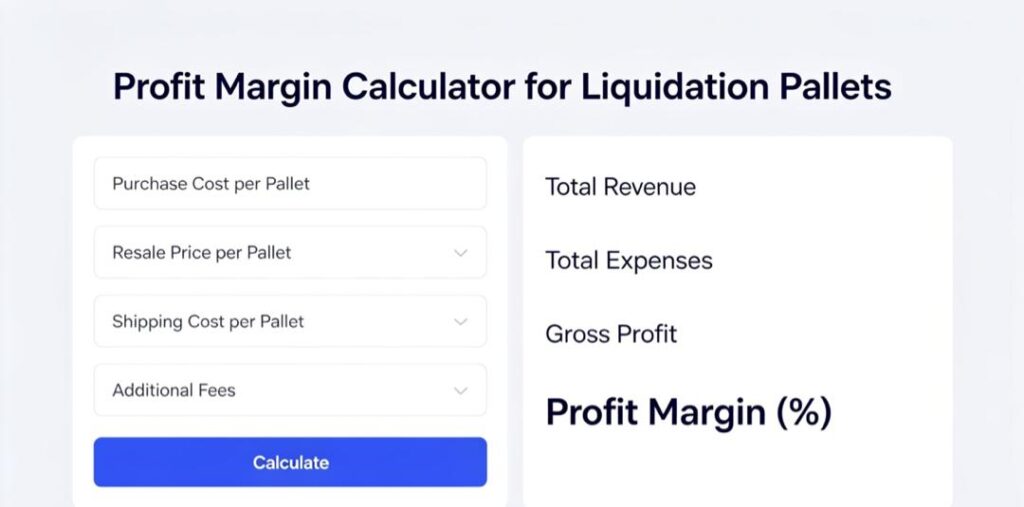
A buyer should calculate the complete cost of acquiring and selling the inventory.
Important costs can include:
- Pallet purchase price
- Freight
- Storage
- Packaging
- Marketplace fees
- Payment processing
- Labor
- Cleaning or testing
- Returns
- Unsellable merchandise
For this reason, the difference between a pallet’s purchase price and its estimated retail value should not automatically be considered profit.
What Should You Check Before Buying?
Before purchasing a liquidation pallet, evaluate several factors.
1. Product Category
Make sure you understand the products and have customers who may want them.
2. Condition
Understand whether the inventory is new, returned, open box, used, or mixed condition.
3. Manifest
If a manifest is provided, review it carefully.
4. Price
Compare the purchase price with realistic resale prices.
5. Shipping
Calculate your delivered cost before making a purchasing decision.
6. Storage
Make sure you have enough space to receive, inspect, organize, and store the inventory.
7. Selling Strategy
Know where you intend to sell the products before purchasing the pallet.
Common Mistakes When Buying Liquidation Pallets
Focusing Only on Retail Value
Estimated retail value does not guarantee your actual resale revenue.
Ignoring Shipping
Freight can have a major impact on the total acquisition cost.
Buying Products You Don’t Understand
Unfamiliar products can be harder to test, price, list, and sell.
Ordering Too Much Inventory
Large orders can create storage and cash-flow challenges.
Failing to Research Demand
A product can have a high retail price but still be difficult to sell if there is limited demand.
How to Get Started With Liquidation Pallets
If you are new to liquidation inventory, start by choosing a product category that fits your experience and selling strategy.
Research the products, understand their condition, calculate your complete acquisition cost, and determine where you will sell the inventory.
If you are ready to explore different categories, you can browse our:
- Amazon Pallets
- Walmart Pallets
- Target Pallets
- Electronics Pallets
- Clothing Pallets
- General Merchandise Pallets
- Health & Beauty Pallets
Frequently Asked Questions About Pallet Liquidation
What is pallet liquidation?
Pallet liquidation is the sale of bulk merchandise through liquidation channels. Inventory can include customer returns, overstock, shelf pulls, discontinued products, seasonal inventory, and other excess merchandise.
Are liquidation pallets new?
Not necessarily. Depending on the source, liquidation pallets can contain new, overstock, open-box, returned, used, or mixed-condition merchandise.
What is a customer return pallet?
A customer return pallet contains merchandise that has been returned after purchase. The condition of individual products can vary.
What is an overstock pallet?
An overstock pallet contains excess merchandise that a retailer or supplier needs to move through another sales channel.
What is a manifested pallet?
A manifested pallet is a liquidation lot accompanied by an inventory list or other product information that helps buyers understand the contents.
Can liquidation pallets be profitable?
They can provide resale opportunities, but profit is not guaranteed. Buyers should calculate purchase costs, shipping, selling fees, storage, product condition, demand, and other expenses.
What type of liquidation pallet should a beginner buy?
There is no single best choice for every beginner. Choose a category you understand and where you have a realistic plan for selling the merchandise.
Explore Liquidation Pallets for Sale
Understanding how liquidation works is the first step. The next step is finding inventory that matches your business, budget, storage capacity, and resale strategy.
Explore our available liquidation pallets for sale or browse a specific category to find inventory that fits your business.
Looking for a specific category? Start with Amazon, Walmart, Target, Electronics, Clothing, General Merchandise, or Health & Beauty pallets and compare the available options.