How to Sell Liquidation Pallets: 10 Ways to Resell Your Inventory
Buying liquidation pallets is only half of the business. The next challenge is learning how to sell liquidation pallets efficiently and turn bulk inventory into individual sales.
Liquidation inventory can contain clothing, electronics, tools, home goods, beauty products, toys, sporting goods, and other merchandise. Because different products attract different customers, successful resellers often use multiple sales channels rather than relying on one method.
The right strategy depends on the products you purchased, their condition, your location, your target customers, and whether you prefer online or local selling.
In this guide, we’ll cover 10 practical ways to sell liquidation inventory, how to choose the right sales channel, how to price products, and how to avoid letting unsold inventory consume your cash and storage space.
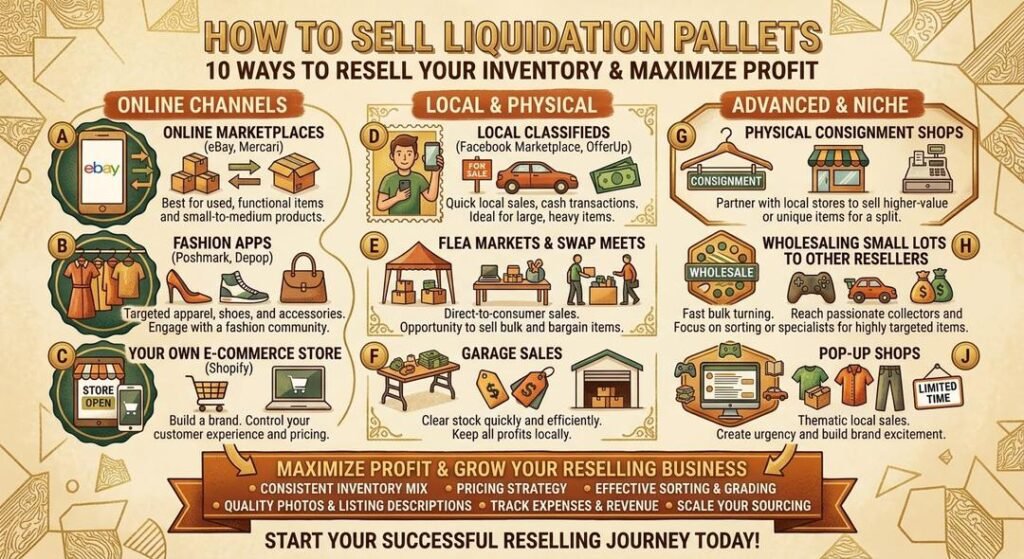
1. Sell Liquidation Products on eBay
eBay can be useful for resellers who want to sell individual products to buyers beyond their local area.
It can be particularly useful for products that customers search for by brand, model, product name, or specific characteristics.
Before listing an item, research comparable products and pay attention to condition.
Your listing should accurately explain:
- Product name and model
- Condition
- Included accessories
- Visible defects
- Measurements where relevant
- Photos of the actual product
- Shipping information
For returned or open-box merchandise, accurate descriptions are especially important because customers need to understand exactly what they’re purchasing.
2. Sell on Facebook Marketplace
Facebook Marketplace can be useful for local resale.
It can work particularly well for products that are expensive or inconvenient to ship.
Examples may include:
- Tools
- Home goods
- Furniture
- Larger appliances
- Outdoor equipment
- Bulk merchandise
Local selling can also allow you to move lower-value products without paying individual shipping costs for every transaction.
Use clear photographs, accurate descriptions, realistic pricing, and a convenient pickup arrangement.
3. Sell Liquidation Products at Flea Markets
Flea markets can be an effective channel for resellers with a broad mixture of inventory.
Customers can physically inspect products, which can be useful for clothing, tools, household goods, accessories, toys, and other merchandise.
You can also create different price levels to encourage customers to purchase multiple items.
For example, you might have:
- Low-cost impulse items
- Mid-priced products
- Higher-value individual items
- Multi-item bundles
If flea markets are part of your strategy, see our guide to the best liquidation pallets to resell at flea markets.
4. Sell Through Your Own Ecommerce Website
Your own ecommerce website gives you greater control over your product presentation and customer experience.
You can create product pages, organize merchandise into categories, collect customer information, and build your own brand rather than depending entirely on an external marketplace.
However, having a website does not automatically generate sales.
You need a strategy for attracting visitors through search engines, social media, advertising, email marketing, repeat customers, or other traffic sources.
If you already have an audience, your own website can become an important part of your resale operation.
5. Sell Through Social Media
Social media can help you showcase new liquidation inventory to potential customers.
Instead of simply posting a product link, consider showing customers what you’re actually receiving and processing.
Content ideas include:
- New pallet arrivals
- Product unboxings
- Before-and-after cleaning
- Individual product demonstrations
- New inventory announcements
- Bundle offers
- Behind-the-scenes inventory sorting
This type of content can help potential customers understand your business and see new products as they become available.
6. Sell Products in Bundles
Not every product needs to be sold individually.
Bundling can be useful when you have several inexpensive or complementary products.
For example:
- Multiple clothing items
- Tool accessory bundles
- Household product bundles
- Beauty product bundles
- Children’s product bundles
- Mixed accessory lots
Bundling can reduce the amount of time you spend creating individual listings and can make lower-value inventory easier to move.
The key is to create bundles that make sense to the customer rather than simply grouping random products together.
7. Sell to Other Resellers
You don’t always have to sell directly to the final consumer.
If you have more inventory than you can process, you may be able to sell some products or smaller lots to other resellers.
Potential buyers may include:
- Flea market vendors
- Online sellers
- Small retailers
- Bin stores
- Local entrepreneurs
- Specialty shops
This approach can reduce the amount of individual listing work required, although selling in bulk generally means accepting a different price than you might achieve through individual retail sales.
8. Sell Through a Local Discount or Pop-Up Store
If you have consistent inventory, a discount retail model can provide another way to move liquidation products.
You could operate through a permanent retail location, temporary pop-up, market stall, or another physical selling environment depending on your business model and local requirements.
This approach can be especially useful when you have a broad mixture of low- and mid-priced merchandise.
Before committing to a physical location, calculate rent, utilities, labor, insurance, permits, inventory costs, and other operating expenses.
9. Sell Specialized Products Through Niche Channels
Some liquidation products are easier to sell when you reach a specific customer group.
For example, tool inventory may be marketed toward contractors, mechanics, homeowners, and DIY customers.
Fashion inventory may appeal to clothing shoppers, boutique customers, or vintage and streetwear communities.
Electronics may be marketed toward technology enthusiasts or buyers looking for specific devices and accessories.
The more clearly you understand the customer for a product, the easier it becomes to choose your sales channel and write a useful listing.
10. Create Your Own Local Customer Network
One of the strongest long-term strategies is building a database of repeat customers.
Instead of finding a new buyer for every product, develop relationships with customers who regularly purchase the categories you sell.
For example, a tool reseller might develop relationships with local contractors, while a clothing seller could build a customer list interested in new apparel arrivals.
With appropriate consent and in accordance with applicable marketing laws, you can use email or other customer communication channels to announce new inventory and promotions.
How to Choose the Right Sales Channel
Don’t choose a sales channel simply because another reseller uses it.
Match the channel to the inventory.
| Inventory | Potential Sales Channels |
|---|---|
| Clothing | eBay, social media, flea markets, website, pop-ups |
| Electronics | eBay, website, local marketplaces, specialty buyers |
| Tools | Facebook Marketplace, eBay, flea markets, local customers |
| General merchandise | Flea markets, Facebook Marketplace, website, discount retail |
| Large products | Local marketplaces, physical retail, local pickup |
| Small shippable products | eBay, ecommerce websites, social selling |
How to Price Liquidation Products for Resale
Pricing is one of the most important parts of learning how to sell liquidation pallets.
Don’t automatically use the original retail price as your selling price.
Instead, research the current market and consider:
- Product condition
- Brand
- Demand
- Competition
- Current comparable prices
- Marketplace fees
- Payment processing costs
- Shipping costs
- Packaging expenses
- Your desired selling speed
For example, a product that originally sold for $100 at retail may not realistically sell for $100 on the secondary market.
Research actual comparable sales whenever possible.
Calculate Your Profit Before Pricing
Your profit isn’t simply your selling price minus what you paid for the pallet.
First calculate your total investment.
Total Inventory Cost = Pallet Price + Freight + Fees + Other Direct Costs
Then account for the costs involved in selling the products.
For a detailed explanation of the numbers, read our liquidation pallet profit and ROI guide.
What Should You Do With Slow-Moving Products?
Every reseller eventually encounters inventory that doesn’t sell as quickly as expected.
Don’t automatically keep the same price forever.
Instead, consider:
- Reducing the price
- Creating a bundle
- Changing the sales channel
- Offering local pickup
- Running a clearance promotion
- Selling the item to another reseller
- Using the item as part of a promotional offer
Storage has a cost, even if you don’t pay a separate warehouse bill. Inventory occupying your space cannot be replaced by faster-moving products.
How to Organize Your Liquidation Inventory
Organization becomes increasingly important as your business grows.
Create separate inventory categories such as:
- Ready to list
- Listed
- Sold
- Needs testing
- Needs cleaning
- Needs repair
- Clearance
- Unsellable
Assigning inventory locations can also help you find products quickly after receiving an order.
For larger operations, consider using inventory management software or a spreadsheet to track SKU numbers, purchase costs, listing prices, sales prices, and inventory locations.
How to Sell Customer Returns
Customer-return merchandise requires special attention because condition can vary.
Don’t list a returned product as new unless its actual condition supports that description.
Inspect the product before listing it.
Check:
- Functionality
- Physical condition
- Packaging
- Accessories
- Missing components
- Signs of use
- Visible damage
Then create a listing that accurately communicates the condition to potential customers.
How to Sell Tool Liquidation Inventory
Tools can be sold through several channels because both consumers and professionals may be interested in them.
For example, power tools can be listed individually online or sold locally.
Current Pallet Liquidation Mart inventory includes wholesale power tools, Echo tool pallets, and DeWalt, Ryobi & Milwaukee pallets.
When reselling tools, provide accurate information about model numbers, condition, batteries, chargers, accessories, and functionality where applicable.
How to Sell Clothing From a Liquidation Pallet
Clothing should generally be sorted before listing.
Organize products by:
- Brand
- Size
- Product type
- Condition
- Style
- Season
Photograph important details and disclose flaws clearly.
You can sell higher-value pieces individually while grouping lower-value products into bundles.
Browse our clothing liquidation pallets if you want to explore apparel inventory.
How to Sell Electronics From a Liquidation Pallet
Electronics should generally be tested before being advertised as working.
Depending on the product, testing may include:
- Power
- Charging
- Display
- Buttons
- Connectivity
- Ports
- Accessories
Products that don’t work should not be represented as functional.
If you’re considering electronics inventory, see our mixed electronics pallets.
How to Sell More of Your Inventory
Getting more sales isn’t always about lowering your prices.
Improve the quality of your listings.
Use:
- Clear product titles
- Accurate descriptions
- High-quality photographs
- Relevant keywords
- Competitive pricing
- Clear shipping information
- Accurate condition descriptions
Also test different sales channels.
A product that doesn’t sell online may perform better at a flea market. A product that doesn’t attract local buyers may perform better on a national marketplace.
Don’t Forget the Cost of Your Time
One of the easiest expenses for new resellers to overlook is labor.
Imagine buying a pallet containing 100 products.
You may need to:
- Unload the pallet
- Sort the products
- Test items
- Clean products
- Take photographs
- Research prices
- Create listings
- Answer customers
- Package orders
- Handle returns
If each product requires significant work, your actual business economics can look very different from a simple pallet-cost calculation.
Track your time so you can identify which inventory categories are most efficient for your business.
How to Build a Repeatable Liquidation Resale System
As your business grows, try to create a repeatable process.
- Source: Find suitable liquidation inventory.
- Receive: Document and organize the shipment.
- Inspect: Determine condition.
- Sort: Separate products by category and resale strategy.
- Price: Research the market.
- List: Create accurate product listings.
- Sell: Use the appropriate sales channels.
- Track: Record revenue and expenses.
- Review: Identify which products performed best.
- Reinvest: Use the results to improve future purchases.
This system can help turn liquidation reselling from random product flipping into a more organized business.
Frequently Asked Questions
What is the best way to sell liquidation pallets?
There isn’t one best method for every reseller. eBay, Facebook Marketplace, flea markets, ecommerce websites, social media, local retail, and direct sales can all work depending on the products and customers.
Can I sell liquidation products on eBay?
Yes. Individual liquidation products can be listed on marketplaces such as eBay, provided the listings comply with the platform’s rules and accurately describe the products and their condition.
Can I sell liquidation pallets on Facebook Marketplace?
Facebook Marketplace can be useful for selling individual products or lots locally. It can be particularly useful for products that are difficult or expensive to ship.
How do I price liquidation products?
Research comparable products and consider condition, demand, competition, selling fees, shipping, packaging, and your desired selling speed. Don’t assume the original retail price is the actual resale price.
Should I sell liquidation products individually or in bundles?
It depends on the inventory. Higher-value products may justify individual listings, while lower-value or complementary products can sometimes be more efficiently sold in bundles.
What should I do with liquidation products that don’t sell?
Consider reducing the price, changing sales channels, bundling the product, offering local pickup, or moving it through clearance. The goal is to prevent slow-moving inventory from consuming your available cash and storage space.
Start Selling Your Liquidation Inventory
Learning how to sell liquidation pallets is ultimately about matching the right products with the right customers and sales channels.
You don’t need to rely on one method. A reseller might sell higher-value products online, move bulky products locally, sell inexpensive items in bundles, and use flea markets or other physical channels for additional inventory.
The more accurately you track your costs, selling prices, fees, and inventory turnover, the better you’ll understand which products are worth buying again.
If you’re ready to source additional inventory, browse our liquidation pallets and wholesale inventory.
You can also continue learning through our liquidation tips and guides, including our articles on liquidation pallet condition grades, pallet profit and ROI, and where to buy liquidation pallets in the USA.
Buy carefully, process your inventory efficiently, and use the sales channel that best matches each product.