Liquidation Pallet Condition Grades Explained: A Buyer’s Guide
If you’re buying liquidation inventory for resale, understanding liquidation pallet condition grades is one of the most important things you can learn.
Two pallets can contain similar products but have very different resale potential because of their condition. One pallet may contain unopened overstock, while another may contain customer returns that require testing, cleaning, repair, or additional inspection.
Understanding the difference helps you make better purchasing decisions, estimate your workload, and build more realistic resale calculations.
In this guide, we’ll explain the most common liquidation inventory conditions, what each condition can mean for resellers, and what you should check before purchasing a pallet.
What Are Liquidation Pallet Condition Grades?
Liquidation suppliers use different terminology to describe the condition of inventory. There is no single universal grading system that applies identically to every supplier, so buyers should always read the specific supplier’s description and condition definitions.
Common descriptions include:
- New
- Overstock
- Shelf pulls
- Open box
- Customer returns
- Used
- Refurbished
- Salvage
- Mixed condition
These descriptions help buyers understand what they may need to do before products are ready for resale.
Why Condition Matters When Buying Liquidation Pallets
Condition affects much more than appearance.
It can influence:
- Resale price
- Testing requirements
- Cleaning time
- Repair costs
- Packaging requirements
- Customer expectations
- Return risk
- How quickly inventory can be listed
For example, an unopened product may be ready for listing shortly after receiving it, while a customer-return product may need to be inspected and tested first.
That additional work should be considered when calculating the economics of a pallet.
1. New Inventory
New inventory generally refers to merchandise that has not been used and is in new condition.
Depending on the particular lot, products may be sealed or otherwise presented as new. Packaging condition can still vary, so buyers should review the supplier’s description carefully.
New inventory can be attractive to resellers because there may be less preparation required before listing.
However, don’t assume that the word “new” automatically means every item will have perfect retail packaging. Always check the specific product description.
2. Overstock Inventory
Overstock liquidation pallets contain merchandise that a retailer or distributor has more of than it currently needs or can sell through its normal channels.
Overstock products may be new and unused, but the exact condition should always be confirmed with the supplier.
For resellers, overstock can be attractive because products may require less processing than customer returns.
Potential advantages include:
- Less testing
- Less cleaning
- Less repair work
- Easier product presentation
- Potentially faster listing
Even with overstock, inspect packaging and product descriptions carefully before making your purchase decision.
3. Shelf Pulls
Shelf pull pallets contain merchandise removed from retail shelves or displays.
A shelf-pull product may never have been purchased by a customer, but it may have been handled in a retail environment.
Packaging can therefore vary.
Some products may look retail-ready, while others may have damaged boxes, stickers, opened packaging, or cosmetic imperfections.
For resellers, shelf pulls can offer an interesting middle ground between traditional new inventory and customer returns.
4. Open-Box Inventory
Open-box merchandise has had its original packaging opened.
Opening a package does not necessarily mean that the product is defective or heavily used. However, the reseller should verify the actual condition before advertising the product as new.
For electronics, tools, appliances, and other functional products, testing can be especially important.
Check:
- Whether the product powers on
- Whether major functions work
- Whether accessories are included
- Whether manuals or documentation are included
- Whether the packaging is intact
5. Customer Returns
Customer return pallets contain products that have previously been purchased and returned.
This is one of the most important conditions for liquidation buyers to understand because the condition of individual products can vary.
A returned item could potentially be unopened, lightly handled, used, damaged, incomplete, or defective.
That means customer-return pallets often require more inspection and processing than straightforward overstock.
Before buying a customer-return pallet, ask:
- What percentage of the inventory is expected to be returns?
- Are the products tested?
- Are accessories included?
- Is the pallet manifested?
- How is damaged inventory handled?
- What does the supplier’s condition description specifically mean?
If you’re considering an Amazon customer-return pallet, compare the specific product description and condition information before purchasing.
6. Refurbished Inventory
Refurbished products have typically undergone some type of inspection, repair, restoration, or reconditioning process.
The exact refurbishment process varies, so buyers should not assume that every refurbished product has gone through the same level of testing.
If you’re buying refurbished electronics or tools, understand what testing or refurbishment has been performed and what warranty or return terms, if any, apply.
7. Used Inventory
Used liquidation inventory has previously been used by consumers or businesses.
Used products can range from lightly used merchandise to products showing significant wear.
The value of used inventory depends heavily on product type and condition.
For example, a used professional tool may still have considerable resale value if it works properly, while a heavily worn fashion item may be much more difficult to sell.
8. Salvage Inventory
Salvage pallets generally represent merchandise with significant damage, missing components, defects, or other issues that prevent normal retail resale.
Salvage inventory may be suitable for buyers who specialize in:
- Repairs
- Parts
- Refurbishment
- Material recovery
- Very low-cost resale
Salvage generally requires more expertise and should not be treated the same way as new or overstock inventory.
Beginners should understand exactly what they are purchasing before entering this type of inventory.
9. Mixed-Condition Pallets
Some liquidation pallets contain products in multiple conditions.
For example, a pallet could contain a mixture of overstock, shelf pulls, open-box products, and customer returns.
Mixed-condition pallets can offer variety, but they also make accurate resale calculations more important.
Don’t calculate your expected revenue as if every product were in perfect condition.
Instead, separate inventory into different condition groups after receiving the pallet and price each group accordingly.
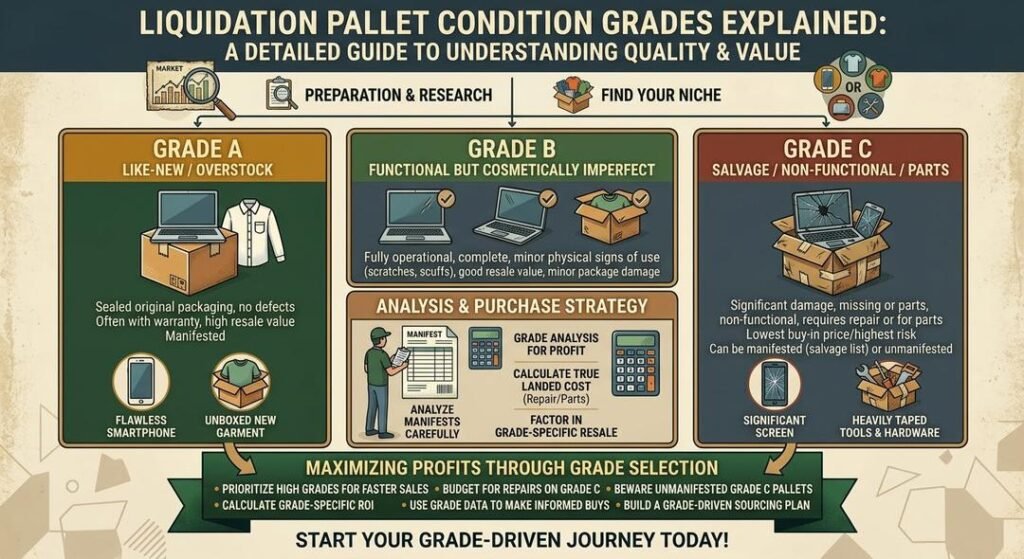
Condition Grades Are Not Universal
One of the most important rules for liquidation buyers is that terminology can vary from supplier to supplier.
A supplier’s “Grade A” may not mean exactly the same thing as another supplier’s “Grade A.”
For that reason, don’t rely on the grade name alone.
Read the actual condition description.
For example, if a listing says “customer returns,” find out whether the supplier provides additional information about testing, completeness, packaging, or defects.
How Condition Affects Different Product Categories
Electronics
Condition is particularly important with electronics because functionality matters.
Testing may include checking whether devices power on, screens function, buttons work, charging works, and essential accessories are present.
Our mixed electronics pallets are an example of the type of inventory where buyers should pay close attention to product condition and the specific listing information.
Tools
For tools, condition can involve both physical appearance and functionality.
Check whether motors operate, batteries hold a charge where applicable, chargers are included, and important components are present.
For example, buyers can review wholesale power tools and specific options such as Echo tool pallets.
Clothing
For clothing, inspect stains, tears, missing tags, sizing, wear, and packaging.
A clothing pallet can contain products with different levels of wear, so sorting inventory before listing is important.
See our clothing liquidation pallets for examples of this product category.
General Merchandise
General merchandise can include many different product types, so condition evaluation depends on the individual items.
One product may need no preparation while another may require cleaning, testing, or repackaging.
How to Inspect a Liquidation Pallet
When your pallet arrives, avoid immediately listing everything for sale.
First, create an inspection process.
Step 1: Photograph the Shipment
Document the condition of the shipment when it arrives, particularly if there are visible signs of damage.
Step 2: Sort the Inventory
Create groups based on product type and condition.
For example:
- New and ready to sell
- Open box
- Needs cleaning
- Needs testing
- Needs repair
- Incomplete
- Unsellable
Step 3: Test Functional Products
For electronics, tools, appliances, and other functional merchandise, test products before advertising them as working.
Step 4: Photograph Products
Take clear photographs that accurately represent the actual condition.
Step 5: Price According to Condition
Don’t use the same price for every item.
Condition should be one of the factors used when setting your selling price.
How Condition Changes Your Profit Calculation
Condition affects both revenue and expenses.
Consider a hypothetical pallet purchased for $600 with $100 in freight.
Your initial landed cost would be:
$600 + $100 = $700
Now imagine that some products are ready to sell while others require cleaning, testing, or repair.
Your actual costs may include:
- Inventory purchase
- Freight
- Repair materials
- Cleaning supplies
- Replacement parts
- Packaging
- Marketplace fees
- Shipping to customers
These costs should be included when calculating your actual profit.
For a complete explanation, read our guide on how to calculate liquidation pallet profit and ROI.
Which Condition Is Best for Beginners?
There is no universal answer.
New or overstock inventory may require less processing, but it can also have a higher purchase price.
Customer returns may provide opportunities at different price points, but they can require more testing and sorting.
Salvage can be less suitable for beginners because it often requires specialized knowledge and repair capabilities.
The best choice is the condition that matches your experience, budget, equipment, and sales strategy.
Questions to Ask a Liquidation Supplier
Before buying, consider asking:
- What is the condition of the inventory?
- Is the pallet mixed condition?
- Are customer returns included?
- Are products tested?
- Are accessories included?
- Is there a manifest?
- Are photographs representative of the actual inventory?
- What happens if products arrive damaged?
- What are the shipping terms?
- What are the applicable return or cancellation policies?
Clear answers to these questions can help you understand the purchase before committing your money.
Common Mistakes Buyers Make With Condition
- Assuming liquidation means new merchandise
- Assuming a condition grade is universal across suppliers
- Ignoring damaged packaging
- Failing to test electronics
- Pricing used products like new products
- Ignoring repair and cleaning costs
- Assuming every product will be complete
- Calculating profit from retail value instead of realistic resale prices
How Condition Fits Into Your Buying Strategy
Condition should be considered alongside price, product category, demand, quantity, shipping, and your ability to process the inventory.
For example, a $500 pallet that requires extensive repairs may require more capital and labor than a $700 pallet containing easier-to-sell merchandise.
This is why experienced resellers don’t simply ask, “How cheap is this pallet?”
They ask, “What will this inventory actually cost me to turn into sellable products?”
Frequently Asked Questions
What are liquidation pallet condition grades?
Condition grades describe the state of liquidation merchandise. Common descriptions include new, overstock, shelf pulls, open box, customer returns, used, refurbished, salvage, and mixed condition. Definitions can vary between suppliers.
What is the best condition for liquidation pallets?
New or overstock inventory may require less preparation, while customer returns and other conditions can require more inspection. The best option depends on your budget, experience, equipment, and resale strategy.
Are customer-return pallets risky?
Customer-return pallets can contain products with varying conditions, so buyers should understand the supplier’s description and be prepared to inspect, test, clean, repair, or reprice inventory where necessary.
What does shelf pull mean?
Shelf pulls generally refer to merchandise removed from retail shelves or displays. The products may not have been purchased by customers, but packaging and appearance can vary.
What does salvage mean in liquidation?
Salvage generally refers to inventory with significant damage, defects, missing components, or other issues that prevent normal retail resale. Salvage may be more suitable for repair, parts, or specialized resale operations.
Does every liquidation supplier use the same grading system?
No. Condition terminology and grading systems can vary. Always read the supplier’s specific condition description rather than relying only on a grade label.
Buy Liquidation Inventory With the Condition in Mind
Understanding liquidation pallet condition grades can help you make more informed purchasing decisions.
Before buying, look beyond the product category and price. Understand the condition, estimate the amount of preparation required, calculate your landed cost, and determine how you will sell the inventory.
If you’re ready to compare available inventory, visit our liquidation pallets and wholesale inventory.
You can also continue researching through our liquidation tips and guides, including our guides on where to buy liquidation pallets and liquidation pallets for beginners.
The better you understand condition before buying, the better prepared you are to price, process, and resell your inventory.