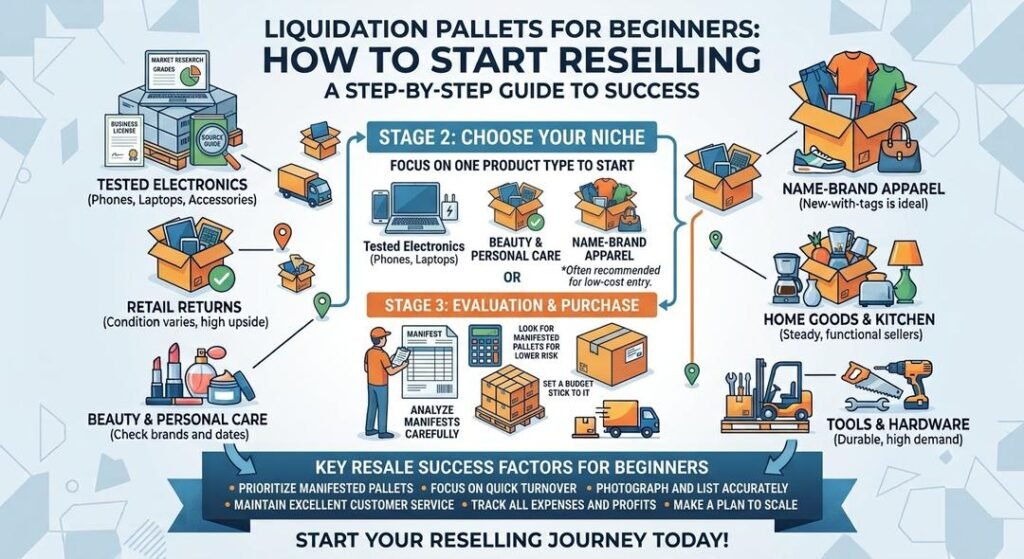
Liquidation Pallets for Beginners: How to Start Reselling
If you’re interested in liquidation pallets for beginners, you may be wondering where to start, what type of inventory to buy, how much money you need, and where you’ll sell the products.
Liquidation reselling can be started on a small scale. You don’t necessarily need a warehouse or a large inventory operation to begin. A first-time reseller can start by learning how liquidation inventory works, choosing a manageable product category, purchasing a reasonable amount of inventory, and building a repeatable process for selling it.
However, liquidation pallets are not guaranteed-profit products. The results depend on what you buy, what you pay, product condition, your selling costs, customer demand, and how efficiently you process the inventory.
This guide explains how beginners can approach liquidation pallets as a resale business and avoid some of the most common mistakes.
What Are Liquidation Pallets?
Liquidation pallets are bulk lots of merchandise sold through wholesale or liquidation channels.
The inventory can come from different sources and may include customer returns, overstock, shelf pulls, excess inventory, closeouts, or other surplus merchandise.
Depending on the pallet, you may receive products such as:
- Electronics
- Clothing
- Tools
- Home goods
- Toys
- Beauty products
- Sporting goods
- General merchandise
- Seasonal products
Condition is extremely important. A pallet containing new or overstock products requires a different resale strategy from one containing customer returns or untested merchandise.
Before buying, make sure you understand the condition and product description rather than assuming that every item will be new or ready for immediate resale.
Can Beginners Make Money Reselling Liquidation Pallets?
Yes, liquidation inventory can create resale opportunities, but there is no guaranteed profit.
Your potential result depends on several variables:
- What you pay for the pallet
- Freight and delivery costs
- The condition of the merchandise
- The products included
- Actual market demand
- Your selling prices
- Marketplace and payment fees
- Packaging and shipping costs
- How much inventory remains unsold
- How much time you spend processing the products
This is why experienced resellers focus on the economics of each purchase rather than assuming that a pallet with a high estimated retail value automatically means high profit.
For a detailed explanation of the calculations, see our guide on how to calculate liquidation pallet profit and ROI.
How Much Money Do You Need to Start?
There is no universal minimum amount required to start because liquidation pallets vary considerably in price.
Your starting budget should cover more than the pallet itself.
Consider creating a budget for:
- Inventory
- Freight or delivery
- Packaging supplies
- Marketplace fees
- Storage
- Cleaning supplies
- Testing equipment if required
- Potential damaged or unsellable merchandise
Most importantly, don’t put your entire available cash balance into inventory.
Keeping some working capital gives you room to handle unexpected expenses and continue operating after your first purchase.
What Is the Best Liquidation Pallet for a Beginner?
There isn’t one universal answer.
The best beginner pallet is generally one that matches your knowledge, budget, storage space, and sales channel.
For example, someone who understands fashion may be more comfortable starting with clothing, while someone who has experience with tools may prefer tool inventory.
Some beginners may also prefer general merchandise because it provides exposure to multiple product categories.
Clothing Pallets
Clothing can be a practical starting point because individual pieces can be sold through online marketplaces, flea markets, local marketplaces, pop-up sales, and physical retail.
The main challenge is organization. You may need to sort inventory by size, type, brand, condition, and season.
Explore our clothing liquidation pallets if apparel fits your business model.
Amazon Pallets
Amazon liquidation pallets can contain a wide variety of consumer products depending on the particular lot.
This can be useful for beginners who want to test different categories, but mixed inventory also means you’ll need to learn how to evaluate different types of products.
See our Amazon liquidation pallets for available inventory.
Walmart Pallets
Walmart liquidation inventory can also contain a broad range of consumer merchandise.
As with any liquidation purchase, evaluate the actual pallet’s description, condition, quantity, price, and shipping costs before deciding whether it fits your business.
You can browse Walmart liquidation pallets as part of your research.
Tool Pallets
Tools can be an excellent category for someone who already understands the products.
Professional and DIY buyers may be interested in power tools, outdoor equipment, accessories, and related products.
However, beginners should pay particular attention to whether tools are tested, whether accessories are included, and whether products are new, open-box, returned, or otherwise used.
Examples of tool inventory include wholesale power tools, Echo tool pallets, and DeWalt, Ryobi & Milwaukee pallets.
Step-by-Step: How to Start Reselling Liquidation Pallets
Step 1: Choose Your Product Category
Don’t begin by searching for the cheapest pallet you can find.
Start by deciding what you want to sell.
Ask yourself:
- What products do I already understand?
- What products do people in my market buy?
- What can I store?
- What can I ship economically?
- Where will I sell the products?
Choosing a category first makes the rest of the buying process much easier.
Step 2: Choose Your Sales Channel
Decide where the inventory will be sold before purchasing it.
Potential channels include:
- eBay
- Facebook Marketplace
- Local marketplaces
- Flea markets
- Your own ecommerce website
- Pop-up shops
- Discount stores
- Specialty retail
Your sales channel should influence the products you buy.
For example, small products that are easy to ship may work particularly well online, while bulky merchandise may be more practical to sell locally.
Step 3: Research Actual Selling Prices
One of the biggest beginner mistakes is confusing an item’s retail price with its actual resale price.
Before buying, research comparable products and look for evidence of what similar items actually sell for.
When possible, use completed or sold listings rather than relying only on active listings.
This gives you a more realistic idea of what customers are willing to pay.
Step 4: Calculate Your Total Cost
Calculate the complete cost of acquiring the inventory.
Landed Cost = Pallet Price + Freight + Fees + Other Direct Costs
Then estimate potential revenue using realistic selling prices.
Don’t assume that every product will sell immediately or at its maximum possible price.
Step 5: Purchase a Manageable Quantity
New resellers should generally focus on learning the process before attempting to scale aggressively.
Your first pallet teaches you how long it takes to:
- Receive inventory
- Sort products
- Test products
- Clean products
- Take photographs
- Create listings
- Answer customer questions
- Package orders
- Handle unsold inventory
Once you understand these processes, you can make better decisions about purchasing additional pallets.
Step 6: Process the Pallet Immediately
Don’t let your inventory sit untouched for weeks.
When the pallet arrives, organize it as quickly as practical.
Create separate groups for:
- Ready-to-sell products
- Products requiring cleaning
- Products requiring testing
- Products requiring repair
- Incomplete products
- Products that may need to be sold for parts
This gives you a clearer picture of what you actually purchased.
How to Price Liquidation Products
Pricing is one of the most important skills you’ll develop as a reseller.
Don’t automatically price every product at a fixed percentage of retail price.
Instead, consider:
- Current market prices
- Product condition
- Brand
- Demand
- Competition
- Shipping costs
- Marketplace fees
- How quickly you want the product to sell
You can also use different pricing strategies for different inventory.
Higher-demand products may justify individual listings, while inexpensive items may be better sold in bundles or grouped lots.
Where Can Beginners Sell Liquidation Inventory?
Beginners don’t have to rely on one sales channel.
Online Marketplaces
Online marketplaces can give you access to customers beyond your local area.
This can be useful for specialized products where local demand may be limited.
Facebook Marketplace
Facebook Marketplace can be useful for local sales, particularly for products that are bulky or expensive to ship.
Flea Markets
Flea markets can work well for sellers with diverse inventory because customers can physically inspect products.
Our guide to the best liquidation pallets for flea markets covers categories that may fit this type of selling environment.
Your Own Website
An ecommerce website gives you greater control over your storefront, branding, customer experience, and product presentation.
However, you are responsible for generating traffic and converting visitors into customers.
How to Avoid Losing Money on Your First Pallet
The safest approach is not to assume that your first purchase will be perfect.
Instead, manage your risk.
- Set a maximum purchasing budget.
- Don’t spend all your available cash on inventory.
- Choose a category you understand.
- Calculate freight before ordering.
- Understand the condition of the products.
- Research resale prices.
- Have a sales plan before the pallet arrives.
- Track revenue and expenses.
- Learn from the first pallet before scaling.
Liquidation reselling becomes much easier when you treat each pallet as a business investment that needs to be measured rather than as a gamble.
Keep Track of Every Pallet
From your first purchase, keep records.
Create a simple spreadsheet containing:
- Date purchased
- Supplier
- Pallet category
- Pallet cost
- Freight cost
- Total investment
- Number of sellable products
- Total revenue
- Marketplace fees
- Shipping expenses
- Net profit
- Days required to sell the inventory
After several purchases, these records will show you which categories and suppliers perform best for your business.
When Should You Scale?
Don’t scale simply because you had one successful pallet.
Scale when you have a repeatable process.
You should have a reasonable understanding of:
- What inventory sells best for you
- Where your customers come from
- How quickly you can process inventory
- Your average selling costs
- Your storage requirements
- Your average profit per pallet
- How much inventory your sales channels can absorb
Once those numbers are becoming predictable, increasing from one pallet to multiple pallets can make more sense.
Larger-volume purchases, including truckloads, should generally come after you have the storage, capital, labor, and sales capacity to handle them.
Liquidation Pallets vs Buying Individual Wholesale Products
Liquidation pallets are different from traditional wholesale purchasing.
With traditional wholesale, buyers may have greater control over exactly which products and quantities they purchase.
Liquidation inventory can provide access to surplus merchandise at discounted wholesale prices, but product selection and condition can vary depending on the liquidation program.
That variability is one reason beginners should understand the terms of each purchase before ordering.
Frequently Asked Questions
Are liquidation pallets good for beginners?
They can be. Beginners should start with a manageable amount of inventory, choose a category they understand, calculate the complete cost, and have a clear resale plan.
What is the easiest liquidation pallet to resell?
There is no universally easiest pallet. Clothing, general merchandise, tools, electronics, and retailer-specific inventory can all work for different sellers. Your knowledge and sales channel are important factors.
How many liquidation pallets should a beginner buy?
There is no fixed number. Starting with a manageable quantity allows you to learn how receiving, sorting, testing, listing, pricing, and selling work before committing more capital.
Can I start a liquidation business from home?
Some resellers can begin from home if they have adequate space and local rules allow it. However, pallet inventory can take considerable room, so storage capacity should be considered before purchasing.
What should I do with products that don’t sell?
Consider adjusting the price, bundling products, changing the sales channel, selling locally, or moving appropriate products through clearance. The goal is to keep inventory moving rather than allowing slow-moving products to consume storage space indefinitely.
Start Your Liquidation Reselling Journey
Starting a liquidation resale business doesn’t require knowing everything on day one.
The most important skills are learning how to evaluate inventory, calculate your costs, understand your customers, choose appropriate sales channels, and track the results of every purchase.
If you’re ready to research your first inventory purchase, browse the available liquidation pallets and wholesale inventory.
You can also continue learning through our liquidation tips and guides, including our detailed guide on how to buy liquidation pallets for the first time.
Start small, calculate carefully, learn from every pallet, and scale only when your resale process is working consistently.