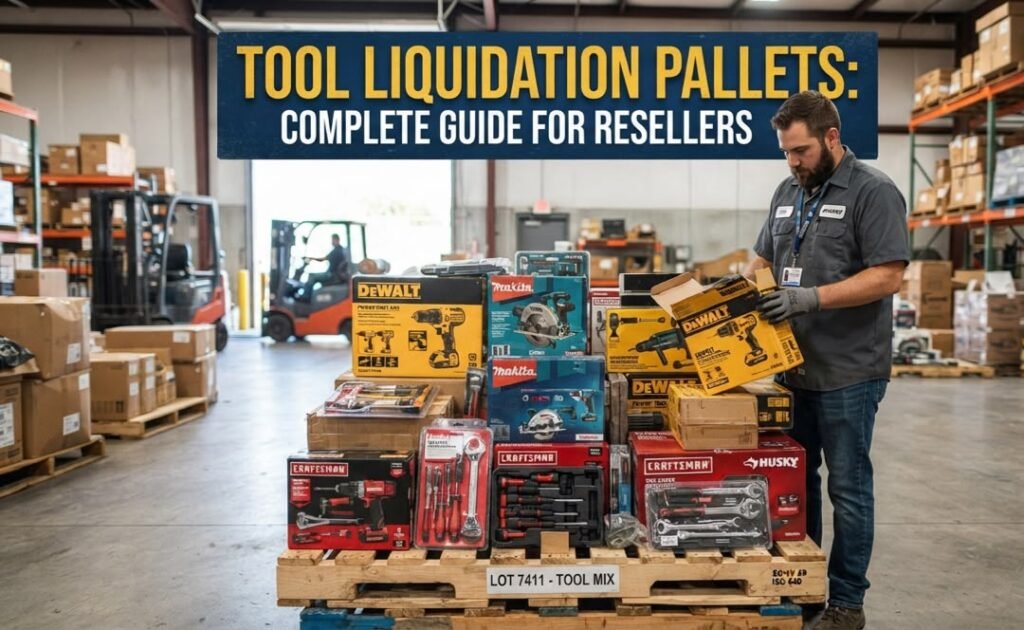
Tool Liquidation Pallets: Complete Guide for Resellers
If you’re looking for wholesale inventory to resell, tool liquidation pallets can provide access to a wide variety of power tools, outdoor equipment, accessories, and other hardware products in bulk.
Liquidation tools can come from customer returns, overstock, shelf pulls, excess inventory, discontinued products, open-box merchandise, and other retail inventory channels. Depending on the pallet, the merchandise may include everything from drills and saws to outdoor power equipment, batteries, chargers, and accessories.
For resellers, the attraction is simple: purchase merchandise in bulk, organize and evaluate the inventory, then sell individual products through online marketplaces, flea markets, local marketplaces, retail stores, or other sales channels.
However, buying a tool pallet isn’t automatically profitable. The condition of the merchandise, completeness of each item, purchase price, freight, current market demand, and your selling costs all affect the potential return.
This guide explains how tool liquidation pallets work, what you may find inside them, how to evaluate a pallet, and how to build a resale strategy around liquidation tools.
What Are Tool Liquidation Pallets?
Tool liquidation pallets are bulk lots of tools and related merchandise sold through liquidation or secondary-market channels.
Instead of purchasing individual tools through traditional retail or wholesale distribution, a reseller purchases a larger quantity of merchandise at once.
Depending on the source, a pallet may contain:
- Power tools
- Hand tools
- Outdoor power equipment
- Lawn and garden tools
- Batteries
- Chargers
- Tool accessories
- Hardware
- Workshop equipment
- Tool storage products
- Mixed-brand merchandise
The exact contents vary from pallet to pallet.
Some pallets may focus on one brand or product category, while others may contain a mixture of different tools.
That makes it important to review the specific pallet description rather than assuming every tool liquidation pallet contains the same products.
Where Do Liquidation Tools Come From?
Liquidation inventory can enter the secondary market for several reasons.
Customer Returns
Customers return products for many reasons. Depending on the retailer’s process, returned tools may be inspected, restocked, refurbished, or sold through liquidation channels.
Returned merchandise can therefore vary significantly in condition.
Overstock
Retailers sometimes have more inventory than they need.
Rather than continuing to store excess products, they may move inventory through liquidation channels.
Shelf Pulls
Shelf-pull merchandise has typically been removed from retail shelves.
The products may have been displayed or handled, and packaging may show signs of handling.
Open-Box Inventory
Open-box tools may have been removed from their original packaging.
The tool may still be functional, but buyers should check the specific condition description.
Discontinued Products
Older models or products being replaced by newer versions may also enter liquidation channels.
For a broader explanation of liquidation inventory, see our What Is Pallet Liquidation? guide.
What Can Be Inside a Tool Liquidation Pallet?
There isn’t one standard assortment.
Depending on the pallet, you may encounter different categories of tools.
Drills
Drills are commonly used by homeowners, contractors, maintenance professionals, and DIY customers.
Cordless drills can be particularly useful for resellers because they are relatively easy to display and list individually.
Impact Drivers
Impact drivers are popular among construction and home-improvement customers.
When evaluating cordless impact tools, check whether batteries, chargers, cases, and other required accessories are included.
Saws
Tool pallets may contain different types of saws, including circular saws, reciprocating saws, jigsaws, and other cutting equipment.
Grinders
Angle grinders and related products can appeal to tradespeople, mechanics, fabricators, and serious DIY customers.
Outdoor Power Equipment
Some liquidation tool pallets may contain lawn and landscaping equipment.
This can include products such as:
- Trimmers
- Blowers
- Chainsaws
- Hedge trimmers
- Edgers
- Outdoor accessories
These products may require additional inspection and testing before resale.
Batteries and Chargers
Batteries and chargers can be important components of cordless tool systems.
When evaluating a pallet, determine whether batteries and chargers are included and whether they can be tested.
A tool without a required battery or charger may have a different resale value from a complete kit.
Popular Tool Brands for Resellers
Brand recognition can influence customer demand, but it should not be the only factor in your buying decision.
Depending on the available inventory, liquidation pallets may contain brands such as:
- Milwaukee
- DeWalt
- Ryobi
- Echo
- Makita
- Bosch
- Craftsman
- Other tool manufacturers
Each brand can attract different customers.
For example, professional contractors may look for established professional tool systems, while homeowners may prioritize affordability and versatility.
The exact brand mix should always be confirmed from the specific pallet listing.
Echo Tool Liquidation Pallets
Echo is particularly associated with outdoor power equipment and landscaping tools.
Potential inventory can include products such as:
- String trimmers
- Blowers
- Chainsaws
- Hedge trimmers
- Edgers
- Outdoor accessories
This type of inventory can appeal to landscapers, homeowners, gardening businesses, property managers, and other customers who need outdoor equipment.
If you’re interested in this category, add your exact Echo Tool Pallet product link here:
[INSERT ECHO TOOL PALLET PRODUCT URL]
Because outdoor equipment can be larger and more complex than small hand tools, local selling can sometimes be useful.
Milwaukee Tool Liquidation Pallets
Milwaukee is strongly associated with professional power tools.
Potential categories include:
- Drills
- Impact drivers
- Saws
- Grinders
- Oscillating tools
- Rotary tools
- Batteries
- Chargers
- Accessories
Milwaukee inventory can appeal to contractors, tradespeople, mechanics, construction workers, and DIY customers.
Add your exact Milwaukee product link here:
[INSERT MILWAUKEE TOOL PALLET PRODUCT URL]
DeWalt, Ryobi and Mixed Tool Pallets
Some resellers prefer mixed-brand pallets because they don’t want to depend on a single manufacturer.
A mixed pallet may give you the opportunity to serve multiple types of customers.
If you have a DeWalt/Ryobi/Milwaukee pallet on your site, link it here:
[INSERT DEWALT/RYOBI/MILWAUKEE PRODUCT URL]
You can also link your dedicated Ryobi Tool Pallet product here:
[INSERT RYOBI TOOL PALLET PRODUCT URL]
New vs. Open-Box vs. Customer-Return Tools
Condition is one of the most important considerations when buying liquidation tools.
New
New merchandise may be unused, but you should still review the supplier’s specific description.
Open Box
Open-box products have been removed from their original packaging.
Packaging may be damaged or incomplete.
Shelf Pulls
Shelf pulls have been removed from retail displays.
They may show handling or packaging wear.
Customer Returns
Customer returns have previously been purchased and returned.
Their condition can vary significantly.
Some may work perfectly, while others may require testing, cleaning, accessories, repair, or further evaluation.
Mixed Condition
Some pallets contain multiple conditions.
This can provide a wide variety of inventory but requires an effective sorting and inspection process.
How to Inspect Liquidation Tools
Inspection is one of the most important steps in the resale process.
Before listing a tool for sale, check the following where practical.
Physical Condition
Look for:
- Cracks
- Broken components
- Excessive wear
- Missing parts
- Damaged housings
- Corrosion
- Damaged cords
Function
Test the tool when possible.
For battery-powered products, check whether the tool powers on and operates correctly.
Accessories
Check whether the product includes:
- Batteries
- Chargers
- Cases
- Blades
- Bits
- Guards
- Attachments
- Manuals
The accessories can affect the usability and resale value of the product.
Packaging
Packaging condition can influence how you present an item to customers.
Avoid describing an item as new if the condition does not support that description.
How to Calculate the Cost of a Tool Liquidation Pallet
Don’t evaluate a pallet based solely on its advertised purchase price.
Calculate your landed cost.
A simple formula is:
Landed cost = pallet purchase price + freight + other acquisition costs
For example, suppose a hypothetical pallet costs $1,500 and freight costs $350.
Your initial landed cost would be:
$1,500 + $350 = $1,850
But you may still have additional business expenses.
These can include:
- Storage
- Testing
- Cleaning
- Repairs
- Replacement parts
- Packaging
- Marketplace fees
- Labor
- Returns
- Booth fees
- Transportation
These expenses should be considered when calculating your actual profitability.
How to Estimate Tool Resale Value
The original retail price is not necessarily the amount you can sell the tool for.
Instead, research the current market.
Look at:
- Current listings
- Completed sales where available
- Product condition
- Model number
- Included accessories
- Local demand
- Competition
Try to compare the exact model whenever possible.
For example, two drills from the same brand can have significantly different market prices depending on their model, voltage, included accessories, and condition.
Don’t Confuse Retail Value With Profit
Suppose a hypothetical pallet has an advertised retail value of $8,000.
That does not mean you will automatically generate $8,000 in sales.
Some products may:
- Sell below retail
- Require repairs
- Be missing accessories
- Take longer to sell
- Have limited demand
- Remain unsold
This is why experienced resellers calculate potential revenue based on realistic market prices rather than simply using the advertised retail value.
Where Can You Sell Liquidation Tools?
Tool liquidation inventory can potentially be sold through multiple channels.
Flea Markets
Flea markets can work particularly well for tools because customers can inspect products in person.
Read our guide to the Best Liquidation Pallets to Resell at Flea Markets for additional ideas.
Facebook Marketplace
Local marketplaces can be useful for larger tools where shipping would be expensive.
eBay
Individual tools, accessories, replacement parts, and specialized products can potentially be sold through online marketplaces.
Your Own Website
Your website gives you control over product presentation and customer communication.
It also allows you to build your own customer base rather than depending entirely on third-party marketplaces.
Local Retail
Tool stores, discount stores, and other retailers may use liquidation inventory as part of their product mix depending on their business model.
Why Tool Pallets Can Be Attractive to Flea-Market Sellers
Tools have several characteristics that can make them suitable for physical resale.
Customers can:
- Inspect the tool
- Check its condition
- Compare models
- Ask questions
- Test appropriate products
- Take the product home immediately
This can be particularly useful for larger equipment where shipping would be inconvenient.
However, your local customer base should determine which categories you purchase.
A market with many contractors may respond differently from a market dominated by homeowners and bargain shoppers.
How to Organize Your Tool Inventory
Once a pallet arrives, don’t simply put everything on a table.
Create an inventory system.
Category 1: Ready to Sell
These are products that have been inspected and are ready for listing.
Category 2: Needs Testing
Separate products that require testing.
Category 3: Needs Cleaning
Some merchandise may need cleaning before it can be photographed and listed.
Category 4: Missing Accessories
Separate products that need batteries, chargers, cases, or other components.
Category 5: Repair
Keep products requiring repairs separate from ready-to-sell inventory.
Category 6: Unsellable
Products that cannot reasonably be resold should be separated so they don’t become mixed into your active inventory.
This simple system can make a large pallet much easier to manage.
How to Price Liquidation Tools
There isn’t one universal pricing formula.
Your price should consider:
- Current market price
- Condition
- Brand
- Model
- Accessories
- Local competition
- Acquisition cost
- Selling fees
- Customer demand
You can also create different pricing tiers.
For example:
Premium: New or highly desirable products
Standard: Used or open-box products in good condition
Discount: Products with cosmetic wear or missing nonessential accessories
Always describe condition accurately.
Common Mistakes When Buying Tool Liquidation Pallets
Buying Based Only on Brand
A recognizable brand doesn’t guarantee a profitable pallet.
Ignoring Condition
Customer returns can require significant inspection.
Forgetting Freight
Shipping can substantially increase your acquisition cost.
Not Checking Accessories
Missing batteries and chargers can affect usability.
Buying More Than You Can Process
A large pallet isn’t useful if you don’t have the space or time to inspect and sell it.
Assuming Everything Will Sell Quickly
Some products may take longer to move than others.
Using Retail Price as Your Resale Price
Research current market prices instead.
How Many Tool Pallets Should a Beginner Buy?
There is no universal number.
Your order size should match:
- Your budget
- Storage capacity
- Selling experience
- Customer base
- Processing ability
- Available sales channels
If you’re new to liquidation, it can make sense to start at a scale you can realistically inspect and sell.
Once you understand your actual sell-through rate and costs, you can determine whether increasing your purchasing volume makes sense.
Are Tool Liquidation Pallets Profitable?
Tool liquidation pallets can provide resale opportunities, but profit is never guaranteed.
Your result depends on:
- Purchase price
- Freight
- Condition
- Product demand
- Resale prices
- Selling fees
- Repairs
- Labor
- Storage
- Unsold inventory
The goal should be to purchase inventory based on realistic numbers rather than assuming a pallet will automatically produce a particular profit.
How to Build a Tool Resale Business
If tools become a significant part of your business, start tracking your results.
Record:
- Pallet cost
- Freight
- Number of sellable units
- Number of damaged units
- Average selling price
- Sales revenue
- Selling fees
- Repair costs
- Storage costs
- Unsold inventory
After several purchases, you can compare categories and determine which products perform best for your business.
For example, you may discover that smaller cordless tools sell faster online while larger outdoor equipment performs better through local sales.
That information is more valuable than simply looking at a pallet’s advertised retail value.
Frequently Asked Questions About Tool Liquidation Pallets
What are tool liquidation pallets?
Tool liquidation pallets are bulk lots containing tools and related merchandise sold through liquidation channels. They can contain power tools, outdoor equipment, accessories, batteries, chargers, and other products.
Are liquidation tools new?
Not necessarily. Depending on the source, liquidation tools can be new, overstock, shelf pulls, open-box, customer returns, used, or mixed condition.
What brands can I find in tool liquidation pallets?
The brand mix varies by pallet. Depending on availability, liquidation inventory can include brands such as Milwaukee, DeWalt, Ryobi, Echo, Makita, Bosch, Craftsman, and others.
Are tool liquidation pallets good for reselling?
They can provide resale opportunities, but profitability depends on the specific inventory, condition, acquisition cost, demand, and selling expenses.
Should I test liquidation tools before selling them?
Testing is recommended whenever practical, particularly for used, returned, or open-box tools. Accurate condition descriptions help customers understand what they are purchasing.
Are tool pallets good for flea markets?
They can be suitable for flea markets because customers can inspect products in person. Larger tools can also be easier to sell locally than through individual shipping.
How do I calculate tool pallet profit?
Calculate your sales revenue and subtract the complete cost of acquiring and selling the inventory, including the pallet price, freight, fees, repairs, packaging, labor, and other expenses.
Where can I buy tool liquidation pallets?
You can explore available tool inventory through our Tool Liquidation Pallets category and individual tool pallet listings.
Shop Tool Liquidation Pallets
If you’re ready to source tools for resale, start by choosing inventory that matches your customers and selling strategy.
Browse your Tool Liquidation Pallets category to compare available inventory.
You can also connect this article directly to your individual products:
- Echo Tool Pallet
- Milwaukee Tool Pallet
- DeWalt/Ryobi/Milwaukee Pallet
- Ryobi Tool Pallet
- Wholesale Power Tools
Before purchasing, evaluate the condition, product mix, landed cost, accessories, current market prices, and your ability to process and sell the inventory.
The goal isn’t simply to buy the cheapest tool pallet. The goal is to source inventory that fits your customers and gives your business a realistic opportunity to generate sales.