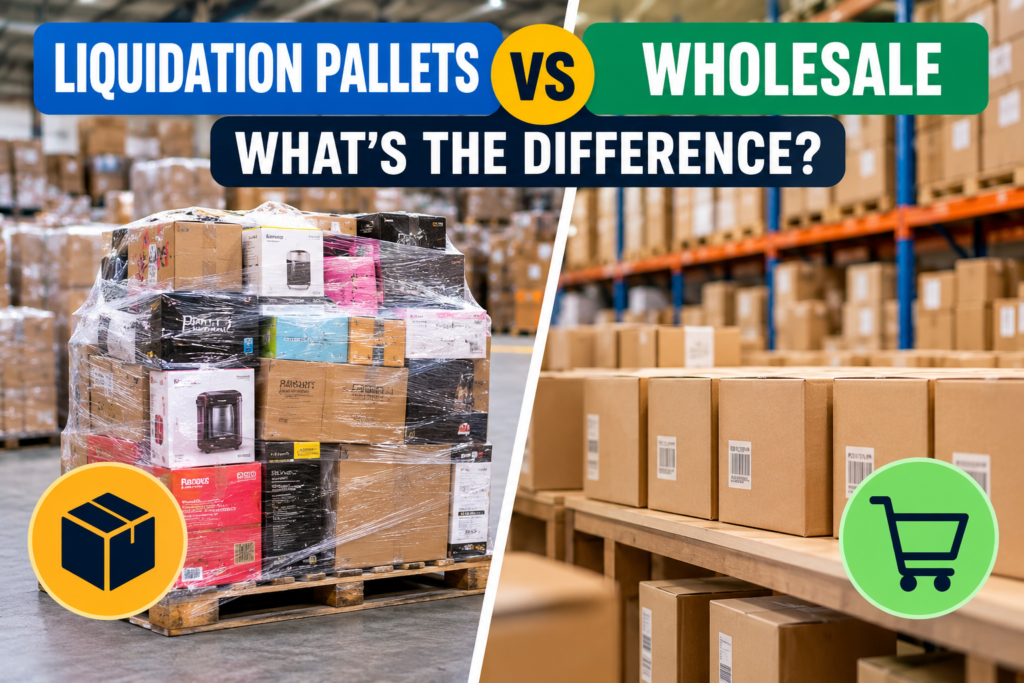
Liquidation Pallets vs Wholesale: What’s the Difference?
If you are starting a resale business, you may come across both liquidation pallets and wholesale inventory. Although the terms are sometimes used interchangeably, they can describe different types of inventory, purchasing arrangements, product conditions and buying risks.
Understanding the difference between liquidation pallets vs wholesale can help you decide what type of inventory fits your business, budget, customers and selling strategy.
In this guide, we explain how liquidation inventory and traditional wholesale inventory compare, what you may receive in each type of purchase, how pricing works, and what to consider before placing an order.
What Are Liquidation Pallets?
Liquidation pallets are bulk quantities of merchandise that are being sold through liquidation channels. The inventory can come from sources such as customer returns, overstock, shelf pulls, excess inventory, discontinued products or other surplus merchandise.
A liquidation pallet may contain products from one category or a mixture of different products, depending on how the inventory was assembled.
For example, a pallet may contain:
- Electronics
- Clothing
- Tools
- General merchandise
- Health and beauty products
- Home improvement products
- Sports and outdoor products
- Retail customer returns
Because liquidation inventory can come from different sources and conditions, buyers should carefully review the product description, condition information, quantities and purchasing terms before ordering.
For more information about condition terminology, see our guide to liquidation pallet condition grades.
What Is Wholesale Inventory?
Wholesale inventory generally refers to merchandise purchased in larger quantities from a manufacturer, distributor, supplier or wholesaler at a price intended for resale.
Traditional wholesale products are often purchased in cases, cartons, units or larger quantities. Depending on the supplier, products may be new and packaged for retail sale.
Wholesale purchasing can be particularly useful for businesses that need consistent products and predictable inventory.
For example, a retailer may purchase 100 units of the same product from a distributor and then sell those units individually to customers.
Liquidation Pallets vs Wholesale: Key Differences
| Factor | Liquidation Pallets | Traditional Wholesale |
|---|---|---|
| Inventory source | Returns, overstock, surplus, shelf pulls and other liquidation channels | Manufacturers, distributors and wholesalers |
| Product condition | May vary depending on the inventory source | Often new and retail-ready, depending on supplier |
| Product variety | Can include mixed products or assorted SKUs | Often more consistent and standardized |
| Quantity | Commonly sold by pallet, lot or truckload | Often sold by case, carton, unit or larger order |
| Inventory consistency | Can vary between lots | Generally more predictable when products remain available |
| Inspection importance | Very important because condition can vary | Still important, but product specifications may be more standardized |
| Resale strategy | May involve sorting, testing, cleaning, repairing or bundling | Usually focused on selling standardized products |
1. Product Condition
One of the biggest differences between liquidation pallets and traditional wholesale is product condition.
Liquidation inventory can include new, overstock, shelf-pull, open-box, customer-returned, used or mixed-condition merchandise, depending on the source.
That does not mean every liquidation pallet contains damaged products. It means buyers need to understand the specific inventory description instead of assuming every item will have the same condition.
Traditional wholesale inventory is often more standardized. A wholesale supplier may sell new products in manufacturer packaging with consistent product specifications.
However, condition and packaging policies vary between suppliers, so buyers should always confirm the terms before purchasing.
2. Product Consistency
Traditional wholesale can be useful when a business needs the same product repeatedly.
For example, an online store selling one particular product may want to reorder the same SKU whenever inventory gets low.
Liquidation inventory can work differently. A particular pallet or lot may contain a specific assortment of products, and the next pallet may not contain exactly the same merchandise.
This can make liquidation attractive for resellers who are comfortable working with changing inventory, but less convenient for businesses that require continuous access to the same products.
3. Buying Liquidation Pallets
When buying liquidation pallets, the buyer should evaluate more than the advertised product value.
Consider:
- Purchase price
- Freight or shipping costs
- Product condition
- Estimated quantity
- Expected resale prices
- Marketplace fees
- Testing or repair costs
- Storage requirements
- Unsold inventory
This is why understanding your liquidation pallet profit and ROI is important before purchasing.
4. Buying Traditional Wholesale
Wholesale purchasing also requires careful cost analysis.
The wholesale price is not necessarily your final business cost. You may also have to account for shipping, storage, marketplace fees, payment processing, advertising, packaging and other operating expenses.
One advantage of standardized wholesale inventory is that it may be easier to calculate your expected selling price when you already know the product, SKU and specifications.
However, the actual economics depend on the supplier, product category, competition and sales channel.
5. Liquidation Can Offer More Variety
One reason resellers consider liquidation pallets is the variety of merchandise available.
Instead of purchasing a large quantity of one product, a reseller may purchase an assorted pallet containing multiple products.
For example, an electronics pallet could potentially contain different types of consumer electronics and accessories. A clothing pallet may contain different sizes, styles or brands.
This can allow a reseller to test different products and identify what sells well with their customers.
Our clothing liquidation pallets category is one example of how liquidation inventory can be organized around a specific product category.
6. Wholesale Can Offer More Predictability
Wholesale purchasing may be preferable for businesses that need predictable inventory.
If a supplier consistently carries the same products, a retailer can build its catalog around specific SKUs and reorder them when necessary.
This can make inventory planning, product listings and advertising easier.
However, product availability can still change because of supplier inventory levels, manufacturer decisions, discontinued products and market demand.
7. Which Categories Can You Buy as Liquidation Pallets?
Liquidation pallets are available across many categories.
Common examples include:
Electronics
Electronics liquidation inventory may include assorted consumer electronics, accessories and other related merchandise. Buyers should pay particular attention to testing requirements and product condition.
See our mixed electronics pallets for an example of category-specific liquidation inventory.
Clothing
Clothing pallets can contain assorted garments, footwear or other apparel-related products. Sorting by size, style, brand and condition can be an important part of the resale process.
Browse our clothing liquidation pallets category.
Tools
Tool liquidation pallets can include power tools, hand tools and other equipment. Resellers should check whether products are new, open-box, used or customer returns.
Examples include our wholesale power tools and DeWalt, Ryobi and Milwaukee pallet.
General Merchandise
General merchandise pallets can contain assorted products from multiple categories. These pallets may provide variety but can require more work to sort, price and list.
For retailer-specific inventory, you can also explore our Amazon pallets and Walmart pallets.
Liquidation Pallets vs Wholesale: Which One Fits Your Business?
There is no single inventory model that fits every reseller. The better choice depends on how your business operates.
Liquidation pallets may make sense if you:
- Are comfortable with changing inventory
- Want to purchase assorted merchandise
- Can inspect, sort or test products
- Have multiple sales channels
- Can handle different product categories
- Understand the risks associated with varying product conditions
Traditional wholesale may make sense if you:
- Need consistent SKUs
- Want predictable product specifications
- Need to reorder the same products
- Operate a specialized online store
- Prefer standardized inventory
- Have established demand for specific products
How to Decide What to Buy
Before purchasing either liquidation or wholesale inventory, start with your customers.
Ask yourself what products they already buy, what price points they respond to and which sales channels you plan to use.
Then calculate your total landed cost.
A simple calculation is:
Landed Cost = Inventory Cost + Freight + Other Direct Purchasing Costs
You can then compare your estimated resale revenue against your total costs.
Do not calculate potential profit using the advertised retail value of a pallet alone. Some products may require discounts, repairs, testing, cleaning, marketplace fees or additional handling before they sell.
For a more detailed process, read our guide on how to calculate liquidation pallet profit.
Common Mistakes When Comparing Liquidation and Wholesale
Ignoring Freight
A pallet’s purchase price is only one part of the cost. Freight can significantly affect the final cost of inventory.
Assuming Every Product Will Sell at Retail Price
Retail price is not necessarily your actual resale price. Research comparable listings and consider your specific sales channel.
Ignoring Condition
A customer-return pallet and a new overstock pallet can have very different resale requirements. Always understand the condition description before buying.
Buying Too Much Inventory
New resellers sometimes focus on the quantity of merchandise rather than their ability to sell it. Storage, listing and handling capacity should be considered before purchasing larger quantities.
Choosing Products Without Checking Demand
Low-cost inventory is not automatically good inventory. Research what customers are actually buying in your target market.
Frequently Asked Questions
Are liquidation pallets the same as wholesale?
No. Liquidation pallets generally refer to surplus, returned, overstock or other liquidation inventory sold in bulk, while traditional wholesale typically involves purchasing products from manufacturers, distributors or wholesalers for resale. The exact inventory and terms vary by supplier.
Are liquidation pallets cheaper than wholesale?
Not necessarily. The purchase price can differ between suppliers and inventory types. Buyers should compare the complete landed cost, product condition, expected resale prices and other expenses rather than comparing the advertised pallet price alone.
Can I make money buying liquidation pallets?
Liquidation pallets can be resold for a profit, but profitability is not guaranteed. Your results depend on inventory cost, condition, demand, selling prices, fees, freight, handling costs and how efficiently you sell the merchandise.
Are liquidation pallets good for beginners?
They can be, provided the buyer starts at a manageable scale and understands condition, freight, pricing and resale risk. Our liquidation pallets for beginners guide explains the process in more detail.
Can I buy both wholesale and liquidation inventory?
Yes. Some resale businesses use both models. For example, a retailer may use wholesale inventory for consistent best-selling products while using liquidation pallets to test new categories or acquire assorted inventory.
Final Thoughts
The main difference between liquidation pallets vs wholesale is the type of inventory and purchasing model involved.
Liquidation inventory can include returns, overstock, shelf pulls, surplus and other merchandise, with product condition and assortment varying by lot. Traditional wholesale is generally more standardized and may provide greater consistency for businesses that need repeatable products.
Neither model automatically guarantees better results. The important step is to understand what you are buying, calculate your complete costs and make sure the inventory fits your customers and sales channels.
If you are ready to explore liquidation inventory, visit our liquidation pallets and wholesale inventory to see the categories currently available.