Best Liquidation Pallets for Resale: What Should You Buy?
If you’re looking for the best liquidation pallets for resale, there isn’t one pallet that is automatically right for every reseller. The best choice depends on your budget, customers, storage space, selling platform, product knowledge, and the amount of work you’re prepared to put into processing inventory.
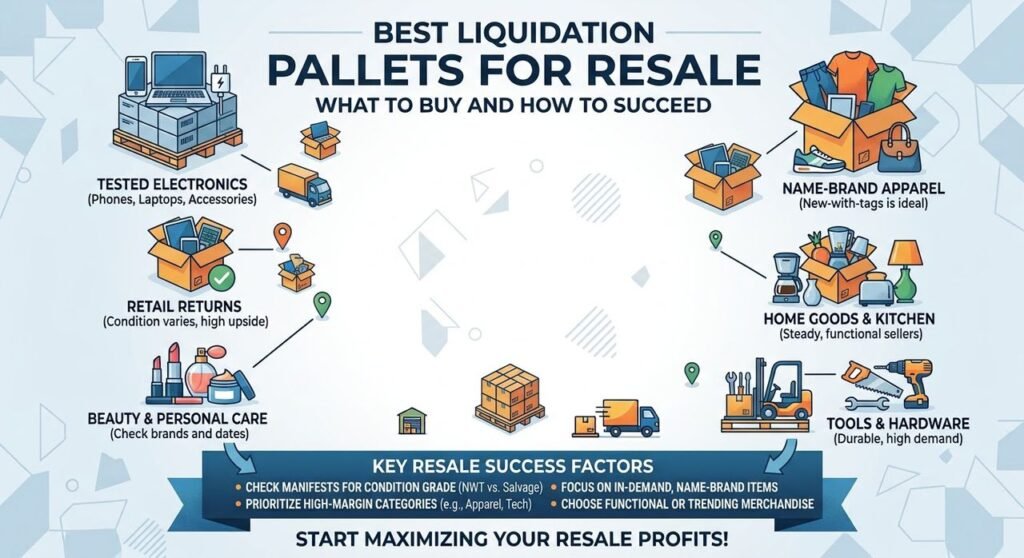
Some resellers prefer clothing because individual pieces can be sorted and sold separately. Others focus on tools, electronics, general merchandise, beauty products, or retailer-specific inventory such as Amazon and Walmart pallets.
The key is to choose inventory based on your resale strategy rather than simply buying the pallet with the lowest price or the highest advertised retail value.
In this guide, we’ll compare popular liquidation pallet categories, explain what makes a pallet attractive for resale, and show you what to evaluate before placing an order.
What Makes a Liquidation Pallet Good for Resale?
A good resale pallet should match your ability to buy, process, store, price, and sell the inventory.
Before choosing a pallet, consider these factors:
- Demand: Are customers actively looking for the products?
- Purchase price: Does the pallet fit your available budget?
- Condition: Are the products new, overstock, shelf pulls, open-box, customer returns, or mixed condition?
- Resale channels: Can you sell the products through eBay, Facebook Marketplace, flea markets, your website, or another channel?
- Storage: Do you have enough room for the entire shipment?
- Processing: How much sorting, testing, cleaning, photographing, or listing will be required?
- Shipping: Have you included freight in your total cost?
The most expensive pallet isn’t necessarily the best pallet, and the cheapest pallet isn’t necessarily the best deal.
1. Amazon Liquidation Pallets
Amazon-related liquidation inventory can be attractive to resellers because the merchandise can span multiple consumer categories.
Depending on the particular lot, Amazon liquidation inventory may include electronics, home goods, toys, apparel, sporting goods, beauty products, kitchen products, tools, and other general merchandise.
This variety can be useful for resellers who operate across several sales channels rather than specializing in one product type.
For example, you could list higher-value items individually online while moving lower-value merchandise through local markets or other sales channels.
See our Amazon liquidation pallets if this category fits your resale model.
2. Walmart Liquidation Pallets
Walmart-related liquidation pallets can also be useful for general merchandise resellers because the inventory can cover a broad range of consumer products.
The important consideration is not simply the retailer name. You should evaluate the specific pallet, its condition, product mix, quantity, price, and expected selling costs.
Walmart inventory may be particularly interesting to businesses that already have customers shopping for household goods, apparel, seasonal merchandise, toys, tools, and other everyday products.
Browse our Walmart liquidation pallets to see the available selection.
3. Electronics Liquidation Pallets
Electronics liquidation pallets are another popular option for resellers.
Electronics can include products such as headphones, speakers, accessories, small devices, smart-home products, and other consumer electronics, depending on the pallet.
The biggest consideration with electronics is condition.
A reseller needs to understand whether products are new, open-box, tested returns, untested returns, incomplete, or damaged. Testing and sorting can require additional time and equipment.
If you already understand electronics and have an established sales channel, this category can make sense. If you’re completely new to resale, you may want to start with inventory that requires less technical testing.
Our mixed electronics pallets are one option to evaluate.
4. Clothing Liquidation Pallets
Clothing is another major category for liquidation resellers.
Apparel can be sold individually, in bundles, through markets, at pop-up shops, through online marketplaces, or through a physical retail operation.
One advantage is that you don’t necessarily need specialized technical knowledge to evaluate every item. You can generally sort inventory according to brand, size, category, condition, and style.
However, clothing pallets also require organization. A pallet containing hundreds of pieces can take considerable time to sort, photograph, measure, price, and list.
Our clothing liquidation pallets include different types of apparel inventory.
5. Tool Liquidation Pallets
Tools can be an interesting category for resellers who understand the products and have access to contractors, homeowners, DIY customers, mechanics, or other buyers.
Tool pallets may contain drills, saws, grinders, outdoor equipment, accessories, and other products depending on the specific lot.
Brand recognition can also influence how customers evaluate individual tools. Current Pallet Liquidation Mart inventory includes wholesale power tools as well as specific tool-brand pallets.
For example, you can compare a wholesale power tools pallet with more specialized options such as Echo tool pallets or DeWalt, Ryobi & Milwaukee pallets.
When buying tools, pay close attention to whether products are tested and whether batteries, chargers, cases, or other accessories are included.
6. General Merchandise Pallets
General merchandise pallets are designed for buyers who want a broader product mix.
Instead of specializing in one category, you may receive a combination of household products, toys, accessories, small appliances, seasonal merchandise, tools, and other consumer goods.
This can be useful for flea market sellers, discount retailers, bin stores, and online sellers who are comfortable listing different types of products.
The trade-off is that mixed inventory can require more organization because each product category may need a different selling strategy.
7. Branded Clothing and Fashion Pallets
Branded apparel can be attractive to resellers who understand fashion and have customers looking for recognizable labels.
For example, Pallet Liquidation Mart currently lists clothing inventory including Nike, Zara, Lululemon, Essential, and other apparel products.
Branded inventory can give you additional ways to position individual products, but always verify the condition, product details, sizing, and authenticity information supplied for a particular lot before advertising products to customers.
How to Choose the Right Pallet for Your Business
Instead of asking, “What is the most profitable liquidation pallet?”, ask:
“Which pallet can I realistically turn into sales?”
Use this five-step process.
Step 1: Start With Your Existing Customers
If you already have customers, use their buying behavior to determine what inventory to source.
For example, a seller with a strong following for fashion products may have an easier time selling clothing than electronics.
Step 2: Match the Inventory to Your Sales Channel
Consider where you’ll sell each item.
- eBay: Useful for individually listed products and specialized merchandise.
- Facebook Marketplace: Useful for local sales and larger items.
- Flea markets: Useful for physical, impulse-driven sales.
- Your own website: Useful when you want greater control over your customer experience.
- Physical retail: Useful for businesses with an established location and customer base.
Don’t buy a pallet first and figure out where to sell it afterward. Your sales channel should be part of the buying decision.
Step 3: Calculate Your Landed Cost
Your purchase price isn’t necessarily your total investment.
Use this basic formula:
Landed Cost = Pallet Price + Freight + Fees + Other Direct Costs
Then estimate your realistic revenue rather than assuming every item will sell at full retail price.
Our liquidation pallet profit and ROI guide explains how to perform this calculation in greater detail.
Step 4: Account for Unsold Inventory
Not every product will necessarily sell immediately.
Your calculation should allow for products that require additional work, sell at a discount, remain in inventory longer than expected, or cannot be sold in their original condition.
This is particularly important with customer-return pallets.
Step 5: Consider Your Time
Your time has value.
A pallet containing hundreds of small clothing items may require significant sorting and listing. A pallet containing larger tools may require testing, cleaning, photography, and individual product research.
The pallet with the highest theoretical resale value isn’t necessarily the most attractive if it takes substantially longer to process.
Best Liquidation Pallets for Different Types of Resellers
| Reseller Type | Categories to Consider | Why |
|---|---|---|
| Beginner reseller | General merchandise, clothing | Broad range of potential customers |
| Online seller | Electronics, branded clothing, tools | Individual products can be listed separately |
| Flea market seller | General merchandise, clothing, tools | Variety gives customers multiple price points |
| Tool specialist | Power tools and branded tool pallets | Existing product knowledge can improve buying decisions |
| Fashion reseller | Clothing and branded apparel | Suitable for individual-item resale |
| Multi-category seller | Amazon, Walmart, general merchandise | Wide inventory mix |
Should You Buy a Cheap Liquidation Pallet?
Price should be one factor in your decision, not the entire decision.
A cheap pallet may still be expensive if the inventory is difficult to sell, requires extensive repairs, has high freight costs, or doesn’t match your customer base.
Likewise, a higher-priced pallet can make sense if the inventory matches your business and you have a realistic plan for selling it.
Always compare the complete economics of the purchase.
What About Truckloads?
Once you have experience buying and selling pallets, you may consider increasing your purchasing volume.
A truckload can provide significantly more inventory, but it also requires more capital, storage, labor, and a stronger distribution plan.
Don’t move from one pallet to a truckload simply because the per-unit cost appears attractive. Make sure you already have the infrastructure and sales volume to handle the inventory.
If you’re considering this model, read What Is a Truckload of Liquidation Pallets?
Common Mistakes When Choosing Liquidation Inventory
- Choosing a pallet solely because it has a low price
- Assuming retail value equals resale value
- Ignoring shipping costs
- Failing to understand condition grades
- Buying more inventory than you can store
- Buying products you don’t understand
- Ignoring your target customers
- Assuming every item will sell immediately
- Failing to research comparable resale prices
Is There a Single Best Liquidation Pallet?
No.
The best liquidation pallets for resale are the ones that fit your specific business model.
A clothing reseller may get better results from apparel. A tool specialist may prefer power tools. An electronics seller may have the knowledge and equipment necessary to process returned electronics efficiently.
Your experience, customers, sales channels, budget, and storage capacity should determine what you buy.
Frequently Asked Questions
What are the best liquidation pallets for resale?
Popular categories include Amazon pallets, Walmart pallets, electronics, clothing, tools, and general merchandise. The best option depends on your customers, sales channels, budget, and ability to process the inventory.
What liquidation pallets are easiest for beginners?
Beginners may find clothing or general merchandise easier to understand than highly technical inventory. However, every pallet should be evaluated individually for condition, cost, quantity, and resale potential.
Are electronics liquidation pallets profitable?
Electronics can provide resale opportunities, but profitability depends on the actual product mix, condition, purchase cost, testing requirements, selling fees, shipping, and market demand.
Are clothing pallets good for reselling?
Clothing can work well for resellers because individual pieces can be sold through online marketplaces, local markets, boutiques, flea markets, and other channels. Sorting and listing time should be included in your business calculations.
How do I calculate liquidation pallet profit?
Calculate your total landed cost, estimate realistic resale revenue, subtract selling expenses and other direct costs, and then calculate your profit and ROI. Avoid treating estimated retail value as guaranteed revenue.
Start Comparing Liquidation Inventory
Once you know which category fits your business, the next step is to compare actual inventory rather than choosing based on category alone.
Review the product description, condition, quantity, price, shipping information, and other available details before ordering.
Browse the Pallet Liquidation Mart shop to compare available wholesale inventory.
You can also continue researching through our liquidation tips and guides before making your next purchasing decision.
Choose inventory that fits your business—not simply the pallet with the biggest advertised retail value.